This is course lessons are taken from The Trading Greek. Here is the 10hours video link: Beginner to Millionaire Trader in 2025.
My Rules and Notes: The reason for revisiting the basics of forex trading is to learn a more accurate way to track how smart money enters the market.
To refresh my mind about the Forex market, just read this article. It’s simple, easy, short, and clear. So, no main points here.
What is Forex?
FOREIGN EXCHANGE = FOREX
Global marketplace where the world’s currencies exchange hands at a mutually agreed rate. This exchange rate change every second so the market is constantly fluctuating.
Forex is the largest financial market in the world with a average daily trading volume of $5.1 Trillion.
What is Forex Trading?
Conversion of one currency into another. Example: exchanging pounds to dollar.
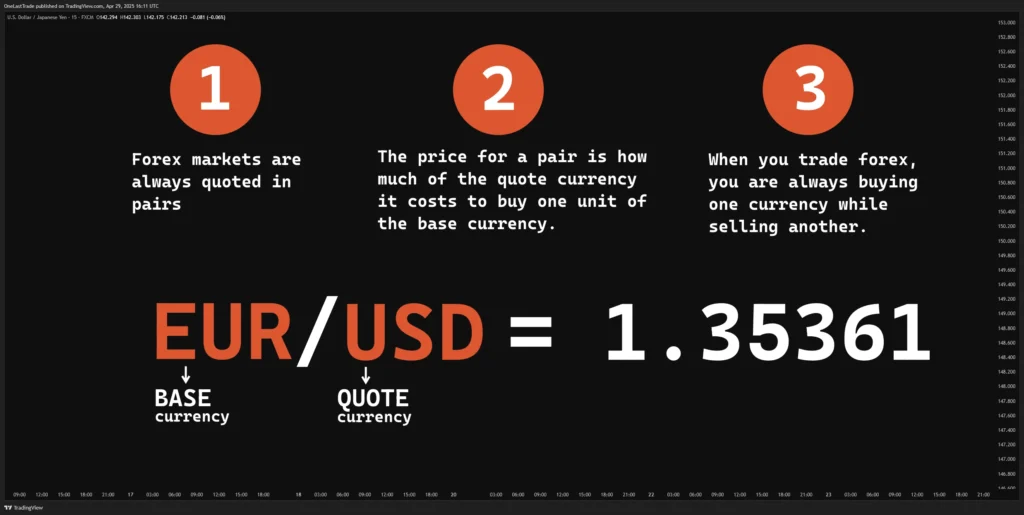
Learning from above image:
- If EUR/USD = 1.35361, then to purchase 1 EURO I have to pay 1.35361 USD.
How Forex Trading Works?
BUY EUR/USD:
- When I expect the price of EUR to rise so I buy EUR (Base currency) and sell USD (Quote currency).
- If the EUR strengthens against the USD, I make money.
SELL EUR/USD:
- When I expect the price of EUR to fall so I sell EUR (Base currency) and buy USD (Quote currency).
- If the EUR weakens against the USD, I make money.
Important Points:
- For one currency to go up, there will be another weakening against it.
- All currencies cannot go up at the same time.
- There is always going to be a winner and loser.
- Forex traders weigh up whether a currency looks likely to strengthen or weaken against another, then trade that pair accordingly.
Who Trades Forex?
- Big Banks & Large Financial Institutions.
- Central Banks & Government.
- Large Commercial Companies.
- Retail Traders.
So, what we can do as retail traders is try to trade alongside big banks and large financial institutions by following their footprints not against them.
How do you determine whether a currency pair is going up or down?
Answer – The Truth is as a Retail Trader: I don’t know. We can’t predict where the market wants to go because Trading is a probability game, which means that every trade outcome is random, no matter how confident I am.
However, we can increase the probability of us winning by developing an edge. An edge is what separates winning traders from losing traders.
Your Edge = Your Trading Strategy that helps you make more profit than losses.
To develop my edge I have to master these 3M’s.
- METHOD: I need to have an trading strategy that works in every market conditions.
- MONEY MANAGEMENT: I need to know how to preserve my capital so I can grow my trading account instead of blowing it and losing my money. That means to take trade with High Risk-to-Reward ratio and while keeping Risk consistent.
- MINDSET: How can I manage and control my emotions when trading a live account, especially when my hard-earned money is on the line. Fear, greed, and FOMO can lead me to take bad trades and make poor decisions.
Currency Pairs and ISO Code.
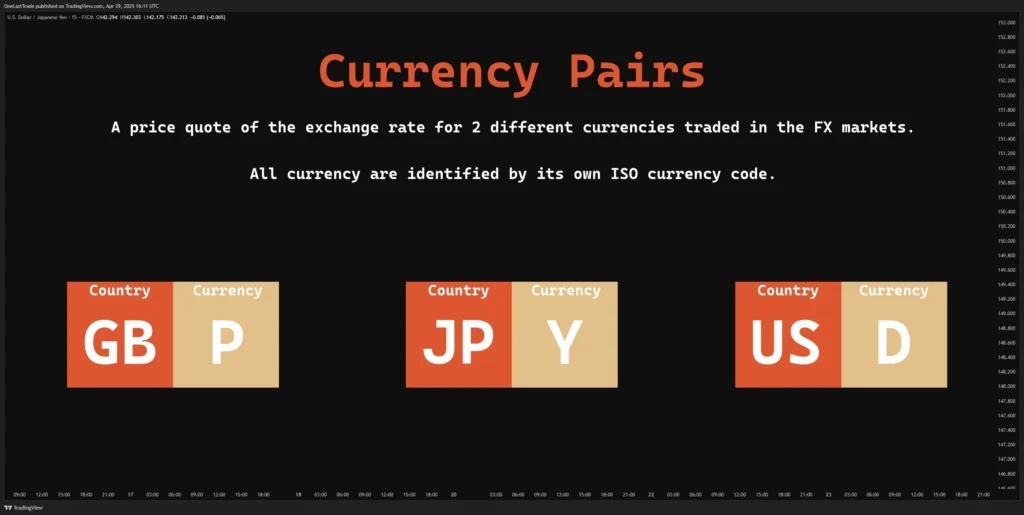
List of Currency Pairs: Major, Minor & Exotics.
| Major | Minor | Exotics |
| – Pairs that include USD | – Pairs that include any two of major currencies except the USD | – Pairs that include one major currency and one currency from emerging markets |
| EUR/USD | EUR/JPY | USD/SGD |
| GBP/USD | EUR/CHF | USD/THB |
| NZD/USD | GBP/JPY | EUR/HUG |
| AUD/USD | AUD/CAD | AUD/MXN |
| USD/JPY | AUD/CHF | CAD/SGD |
| USD/CHF | – | – |
| USD/CAD | – | – |
Important Note: Trade only on Major and Minor currency pairs. Always stick to 1 to 4 currency pairs and master them as a beginner.
Forex Language and Lingo
PIPS
- Pip = Percentage in Point.
- Amount of change in the exchange rate for a currency pair.
- A pip is the 4th number after the decimal point (except for Yen pairs).
- 1 pip = 0.0001
- Example: EUR/USD = 1.2468 -> 1.2470 = +2 pips.
Special Case: Pips on Japanese Yen Pairs.
- Japanese Yen pairs only go up to 2 decimal places.
- In JPY, a pip is the 2nd number after the decimal point.
- 1 pip = 0.01
- Example: USD/JPY = 170.64 -> 170.66 = +2 pips.
PIPETTE
- Pipette = micro pips (1/10th of a pip)
- A pipette is the 5th number after the decimal point and (3rd number only in Yen Pairs).
- 1 pipette = 0.00001
- Example: EUR/USD = 1.09263 -> 1.09265 = +0.2 pips.
Lot Size
Forex is traded in lots (size of your position / how many units are you buying or selling).
| Standard Lot | Mini Lot | Micro Lot |
| 1 Lot | 0.1 Lot | 0.01 Lot |
| 100,000 Units | 10,000 Units | 1,000 Units |
| $10/pip | $1/pip | $0.10/pip |
Closing Comment.
That’s it, Simple, Clean and Easy. Just need to read and keep recharging my mind.