
My Rules and Notes: Understanding macroeconomics takes time, so I will go step by step. Including fundamentals will add an extra edge to my trading strategy and success.
- I will focus on Macroeconomics because it covers inflation, interest rates, economic growth, and government policies, all of which influence currency movements and market trends.
- Central banks adjust interest rates and monetary policy together each month. Their sentiment helps predict market direction.
- Geopolitical events play a crucial role in trade confluence, guiding decisions on whether to enter, hold, or exit positions based on economic and political stability.
- Economic data helps us identify and filter high, medium, and low-impact events, allowing us to focus on major market movements and long-term effects.
- Include ForexFactory high-impact news in my trading plan. Test live and review calendar timings for confidence.
Understanding Currency Supply and Demand.
Investors seek the safest currency to protect their wealth. When a currency weakens, demand decreases, supply increases, and lower scarcity leads to price declines. Economic conditions, interest rates, and market sentiment further influence currency values, driving investor decisions.
What are the different types of fundamentals?
| Microeconomics | Macroeconomics |
| Focusing on individual market drivers, supply/demand, consumer behavior. | Focusing on a economy as a whole: Inflation, GDP, employment rates, national debts. |
Which one should I focus on and why, Microeconomics or Macroeconomics?
I should focus on Macroeconomics because of its wider impact on currency values, interest rates, inflation, and overall market trends, which are crucial for forex trading and investment decisions.
Point 1: I will focus on Macroeconomics because it covers inflation, interest rates, economic growth, and government policies, all of which influence currency movements and market trends. ✔
Three key macroeconomic factors affecting forex markets
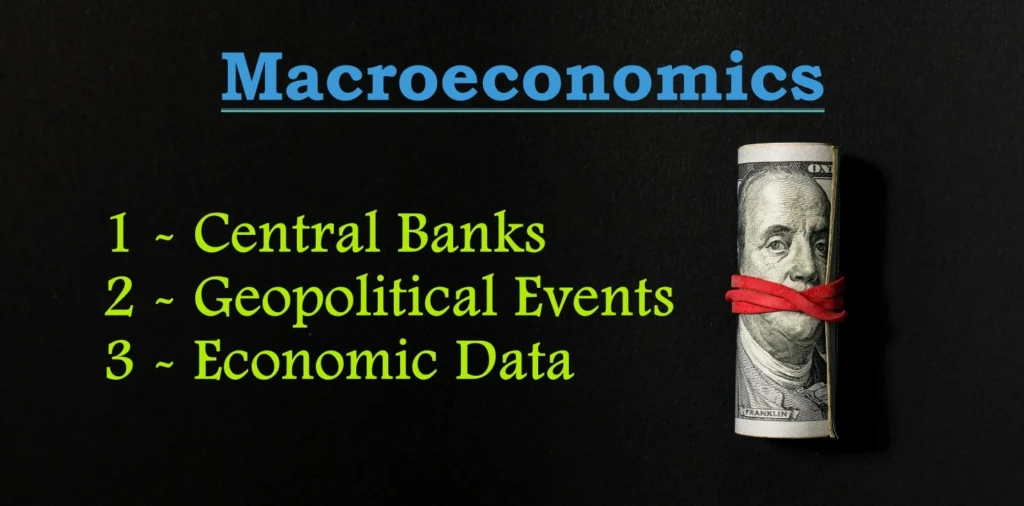
Here, the highest priority is central banks because they control monetary policy, influence interest rates, and impact currency stability.
Note: Fundamentals are not the center of our focus as we prioritize charts, but they provide additional clarity, come in various forms with different importance, and help traders make confident and logical decisions in line with trends. ✔
About Central Banks:
Here is the list of major central banks ranked in order of influence and strength in global financial markets:
- Federal Reserve (USA) – Most influential due to the US dollar’s reserve status.
- European Central Bank (ECB) – Controls the euro, the second most traded currency.
- Bank of England (BoE) – Major impact on global markets with the British pound.
- Bank of Japan (BoJ) – Influences markets with the yen’s international use.
- Swiss National Bank (SNB) – Strong due to Switzerland’s financial sector.
- Bank of Canada (BoC) – Affects commodity-driven economies.
- Reserve Bank of Australia (RBA) – Influences the Australian dollar.
- Reserve Bank of New Zealand (RBNZ) – Impacts the New Zealand dollar.
So, what are the two key factors that central banks influence? The central banks influence interest rates and monetary policy.
Key Points: Interest Rates & Monetary Policy
Here’s a structured table summarizing Interest Rates and Monetary Policy along with their key points:
| Central Banks Influence | Key Points |
|---|---|
| Interest Rates | – Decided monthly by each central bank. – Reflect economic performance. – Help determine market sentiment. – Traders monitor interest rate decisions monthly. – Rate Hike = Hawkish (bullish for currency). – Rate Cut = Dovish (bearish for currency). – No Change = Neutral. |
| Monetary Policy | – Policy statements are released with each rate decision. – Statements explain why rate decisions were made. – They help determine currency direction. – Provide an overview of the economic stance. – Consider key economic factors: – Consumer spending – Labor markets – Cost of living – Inflation (prices going up) or deflation (prices going down) – Gross Domestic Product (GDP) – Help traders analyze interest rate impact on currency trends. |
Point 2: Central banks adjust interest rates and monetary policy together each month. Their sentiment helps predict market direction. ✔
About Geopolitical Events:
- Geopolitical Events & Market Impact – Real-world events like trade relationships, recessions, and pandemics influence the economy and markets.
- Effects on Supply & Demand – Currency values fluctuate based on supply and demand, where weak currencies lose demand, and strong ones attract it.
- How Geopolitics Affect Markets – Political uncertainty, recessions, and commodity price changes can make currencies volatile and impact their long-term value.
- Examples of Geopolitical Events – Elections, economic summits, and crises like wars or recessions can significantly shift currency markets.
- How to Use Geopolitics in Trading – Traders should align their strategies with economic conditions, avoiding long-term buys in recessions and shorts in strong economies.
- Geopolitical Tracking Apps – Apps like Bloomberg, Reuters, Euronews, TradingView, and CNBC help traders stay updated on global events impacting markets.
So, how do I correctly use geopolitical events? Geopolitical events help filter trade ideas and assist in decision-making. For example, avoid buying long-term during a recession and avoid selling when the economy is booming.
Point 3: Geopolitical events play a crucial role in trade confluence, guiding decisions on whether to enter, hold, or exit positions based on economic and political stability. ✔
About Economic Data:
- What is Economic Data? – Economic data includes news, meetings, and figures from central banks and governments.
- It provides insights into economic performance over specific periods. Reports are released monthly, quarterly, or annually.
- Common examples:
- Unemployment rate – Measures joblessness in an economy.
- Interest rate – Indicates borrowing costs set by central banks.
- Gross Domestic Product (GDP) – Represents overall economic output.
- Central bank and government conferences – Influence economic policies.
How Does Economic Data Affect Us?
- Can trigger price spikes and volatility in forex markets.
- Creates both risks (unexpected market shifts) and opportunities (trading strategies).
- Released almost daily, making its impact constant and unavoidable.
- Some reports cause major market movements, while others have little effect.
Types of Economic Data:
| High-Impact Data | Medium & Low-Impact Data |
| Directly reflects economic health. | Includes reports with smaller market influence. |
| Causes major and long-lasting market movements. | Can be distracting and less relevant for traders. |
So, only focus on high-impact data for major market moves and long-term effects.
Different types of High-Impact Data: Long term Vs Short term effects.
| Long Term Effects | Short Term Effects |
| Interest Rates | PMI |
| Monetary Policy | CPI |
| Central Bank Meetings | GDP |
| Unemployment | Retail Sales |
So, give more priority to long-term effects section. I don’t trade the news actively but stay aware and manage trades accordingly.
How can I use economic data to my advantage?
- Step 1: Check the economic calendar on ForexFactory.
- Helps me to track upcoming news.
- Shows importance of each data.
- Allows me to filter by currency.
- Step 2: Identify only High-Impact Data.
- Focus only on high-impact news. Avoid low~medium impact news and events.
- Allows us to plan ahead, manage trades, or avoid them if data adds risk.
- Track economic performance efficiently by focusing on interest rates, GDP, and employment while ignoring lower-importance data.
- Step 3: Prepare for the week ahead.
- Avoid trading during high-impact events like interest rate decisions and NFP to minimize risk and uncertainty.
- Focus on trading pairs with strong or clear fundamentals. Big news shaping a trade or a stable outlook allowing chart-based decisions.
- Remember, preparation is the key to avoiding failure.
Point 4: Economic data helps us identify and filter high, medium, and low-impact events, allowing us to focus on major market movements and long-term effects. ✔
Configure the ForexFactory Calendar to Track High-Impact Events.
- Visit ForexFactory website to access the Economic Calendar and track high-impact news. Change the time zone and time format to London.
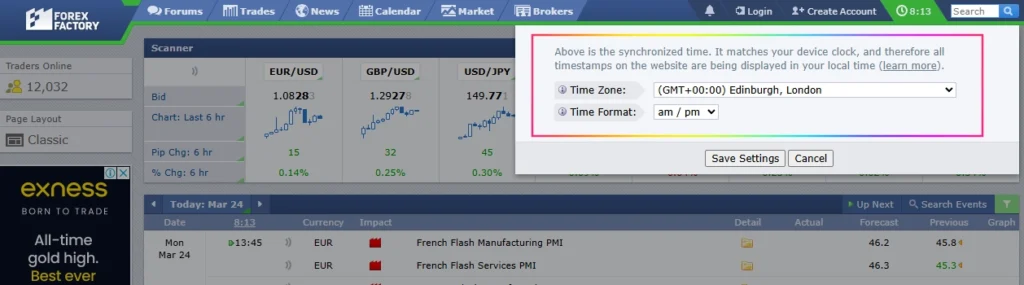
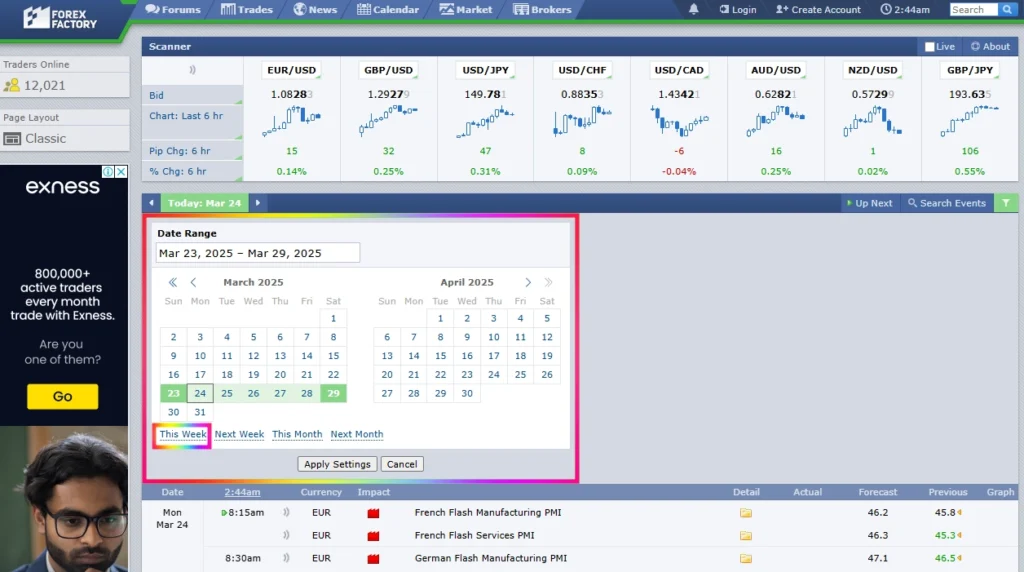
- Change the Date Range settings to – This Week. To track all news and events in the current week ahead.
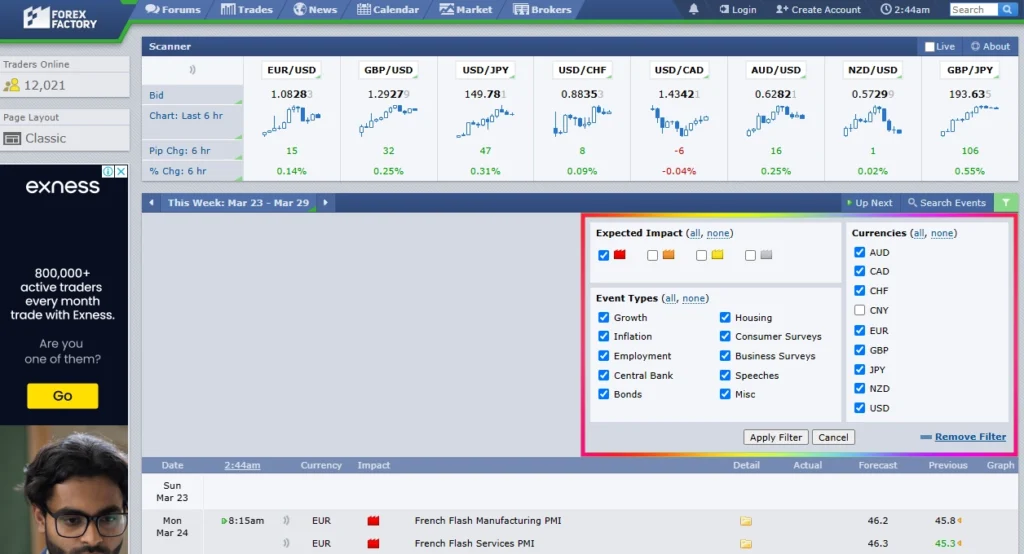
- Filter and keep only the Red Folder, All Event types, untick CNY and save it. (I don’t trade CNY.)
Point 5: Include ForexFactory high-impact news in my trading plan. Test live and review calendar timings for confidence. ✔
Closing Comment.
One last thing to do is to change my computers time to London and check if it helps me. That’s it…!! I am happy that I have completed fundamentals of macroeconomics notes.
Fundamentals are 20%, they add confidence and clarity but aren’t the core of our trading. We use them for filtering and confluence, ensuring we align with the bigger picture while focusing on technical for execution.
By integrating key economic data, we refine trade decisions, avoid unnecessary risks, and stay ahead in volatile markets.