
My Rules and Notes: Revise these notes day to day and keep practicing.
- Just ask myself: Is the market in Uptrend, Downtrend or Sideways?
- Always expect a pullback after a Break of Structure (BOS). This allows you to look for a better trade entry instead of entering too early and getting a poor risk-to-reward (RR) ratio.
- The Swing Range helps identify the internal structures of the market and enables us to work with them effectively.
- Trade from strong structure and target weak structure.
Market Structure: Only 3 ways market can move.
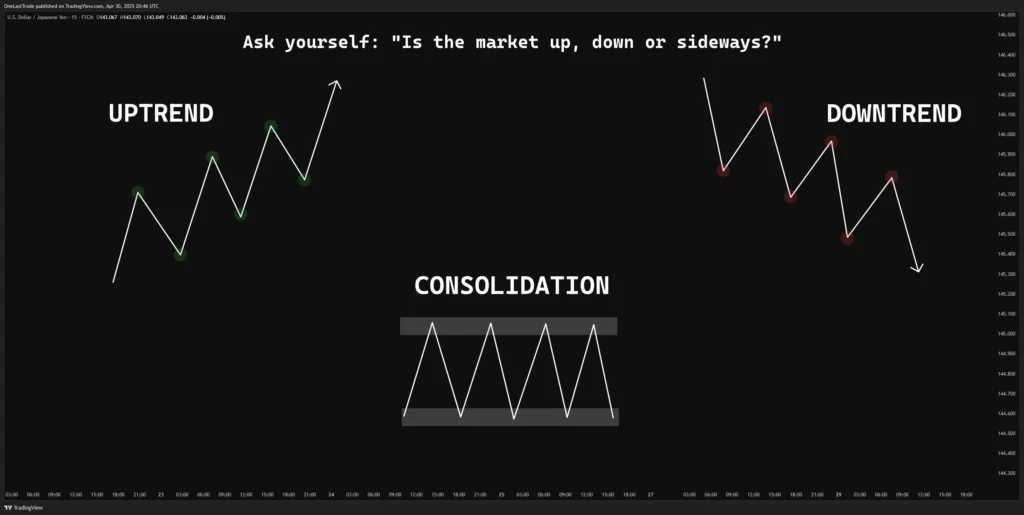
Learning from the above image:
- Just ask myself: Is the market in Uptrend, Downtrend or Sideways?
Pro Tip: Remember, to easily identify which phase the market is in, use this method: if the market isn’t in an uptrend, it’s likely in a downtrend or consolidation. It’s that simple.
Market Structure: Expectation Vs Reality
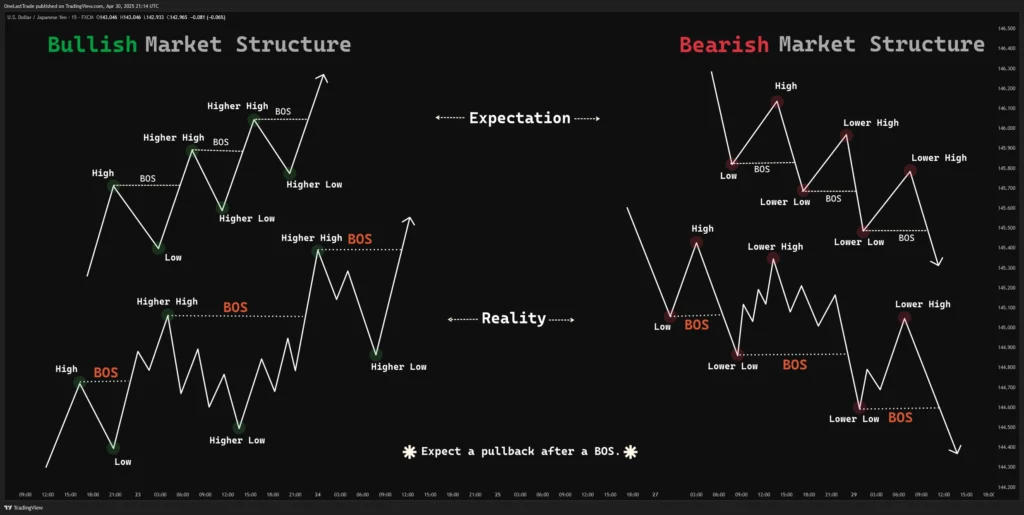
Learning from the above image:
- Expect a pullback after a BOS.
How to determine a valid a swing High/Low?
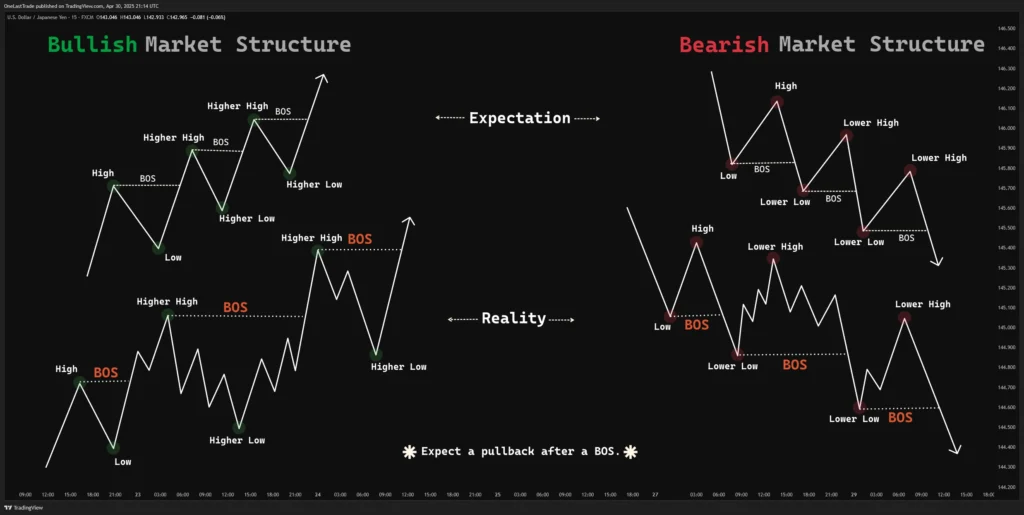
Learning from the above image:
In Bullish Market Structure:
- SWING HIGH: Highest point that lead to Swing Low.
- SWING LOW: Lowest point that creates BOS and lead to Swing High.
In Bearish Market Structure:
- SWING HIGH: Lowest point that lead to Swing High.
- SWING LOW: Highest point that creates BOS and lead to Swing Low.
Important Note: Always expect a pullback after a Break of Structure (BOS). This allows you to look for a better trade entry instead of entering too early and getting a poor risk-to-reward (RR) ratio.
IDENTIFYING SWING RANGE
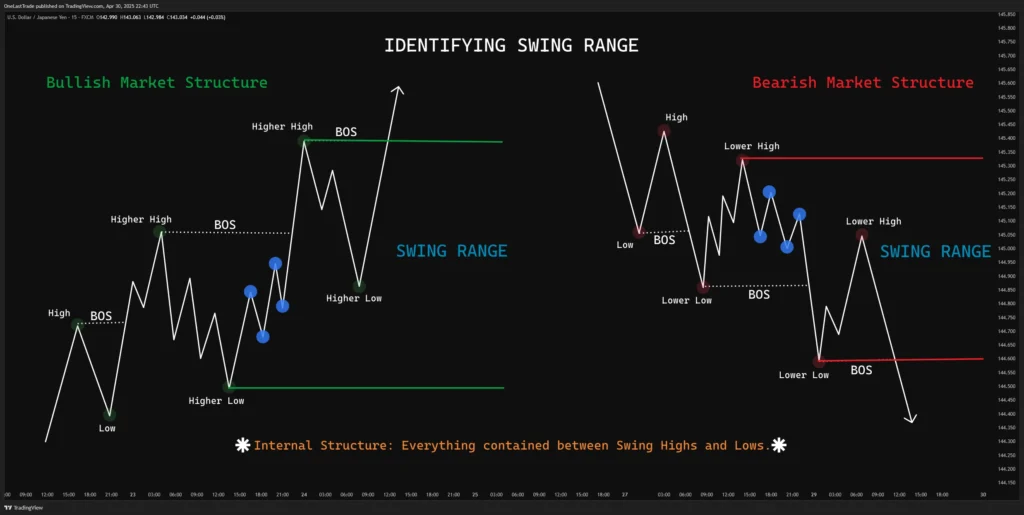
Learning from the above image:
- Question: Why do we need to identify the swing range?
- Answer: We need to identify the swing range to understand and work with the internal structure of the market, which includes all price action contained between the swing highs and swing lows.
Trend Structure Protection
- In an uptrend, higher lows are protected, meaning that as long as the higher lows remain intact and unbroken, the trend is still considered to be in the uptrend phase.
- In a downtrend, lower highs are protected, meaning that as long as the lower highs remain intact and unbroken, the trend is still considered to be in the downtrend phase.
Important Note: The Swing Range helps identify the internal structures of the market and enables us to work with them effectively.
Strong and Weak Highs/Lows
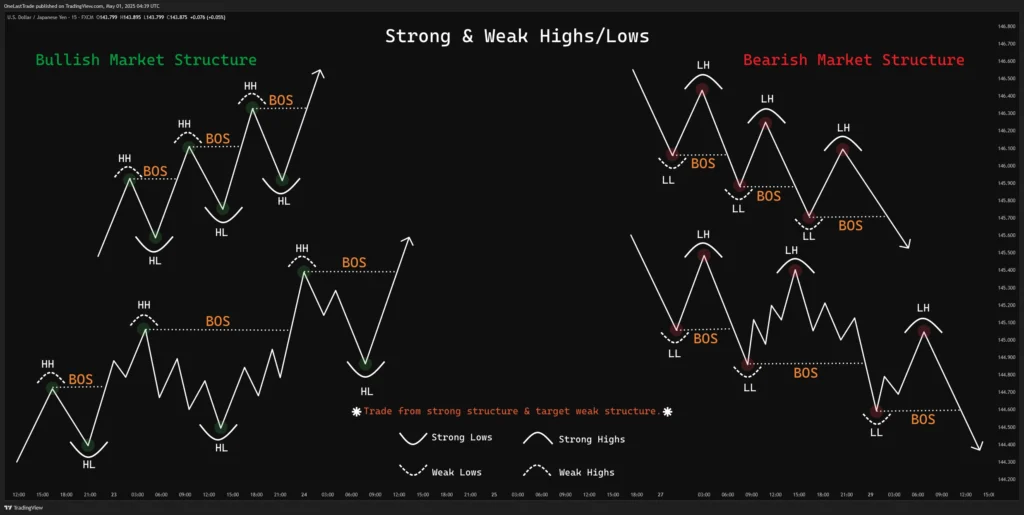
Learning from the above image:
- In a Uptrend, Lows are strong and Highs are weak.
- In a Downtrend, Lows are weak and Highs are strong.
Important Note: Trade from strong structure and target weak structure.
Closing Comment.
These notes are some of the best and most accurate reasoning notes for market structure technical analysis. I loved them. They are clear, concise, and simple.