My Rules and Notes: Each time I plan a trade, I’ll make sure to note the market structure and confirm whether I’m trading within an Impulsive (Swing) move or a Corrective (Sub) move. Understanding the real WHY?
- Always trade in the direction of the trend to stay aligned with market momentum and improve my edge. (Trade only in an clear Uptrend and Downtrend. Don’t trade in the Consolidation Phase.)
- Break of Structure (BoS) confirms trend continuation and validates that the current trend is still intact.
- A Change of Character (ChoCH) forms when price breaks the most recent (structure/swing) high or low against the current trend, indicating a shift in direction.
- The first key principle is to identify the impulsive and corrective moves, not to rush into a trade. Avoid entering directly into an impulsive move to prevent FOMO. Instead, wait for the corrective move, take my time to plan, and then aim to catch the next impulse.
- Impulsive (Swing) moves are the big, clean, trend-continuation moves with higher risk-reward, while Corrective (Sub) moves are smaller, choppy pullbacks with lower risk-reward.
Three Types of Market Structure
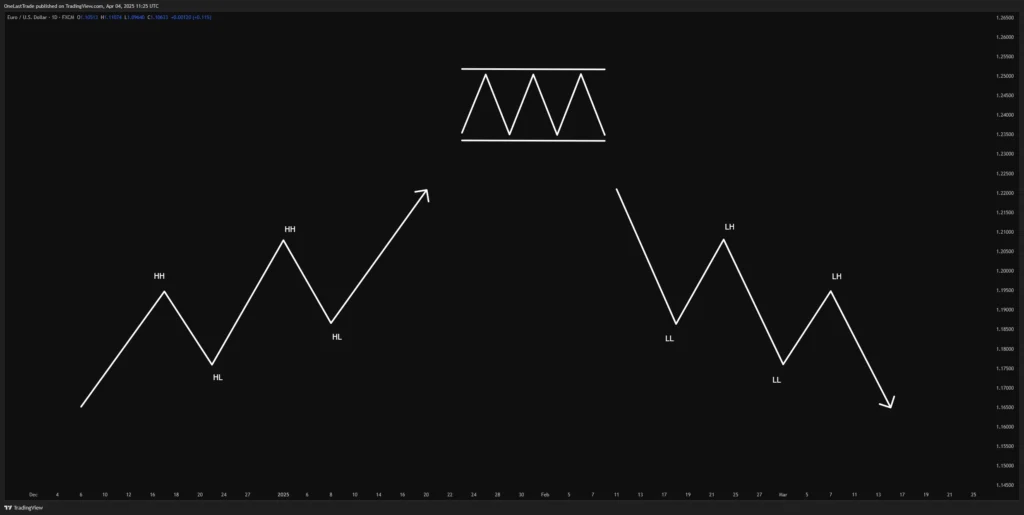
Market moves in three phases: Uptrend – Consolidation – Downtrend.
- Uptrend: Market moves in an Higher Highs (HH) and Higher Lows (HL) formation.
- Consolidation: Market creates equal highs and equal lows, or moves within a defined range without forming clear higher highs or lower lows. (No Clear Direction).
- Downtrend: Market moves in an Lower Lows (LL) and Lower Highs (LH) formation.
Point 1: Always trade in the direction of the trend to stay aligned with market momentum and improve my edge. (Trade only in an clear Uptrend and Downtrend. Don’t trade in the Consolidation Phase.) ✔
Break of Structure: BoS
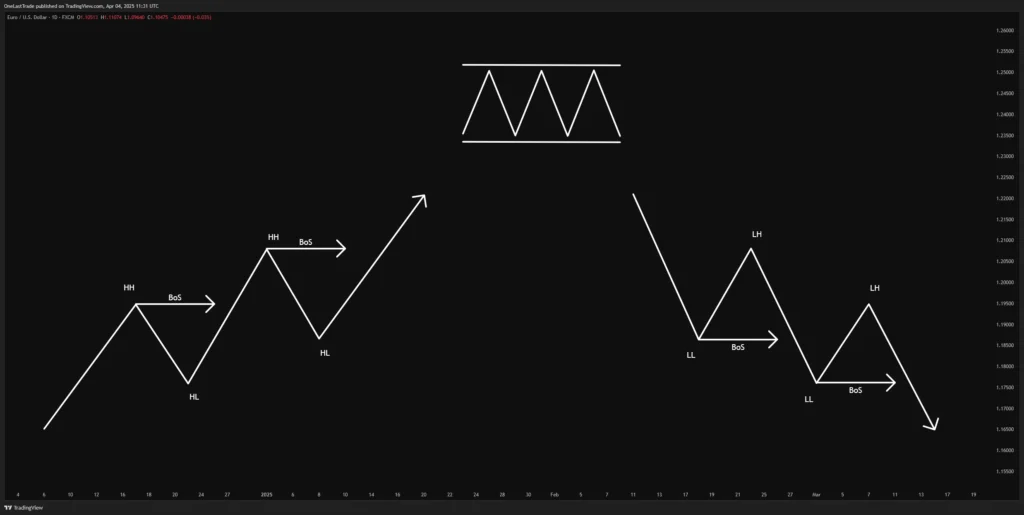
Break of Structure (BoS) is formed when the market breaks a key structural High or Low in the direction of the current trend, confirming that the trend is continuing.
In an uptrend:
A BoS forms when price breaks the previous Higher High (HH).
➤ Confirms continuation of the uptrend.
In a downtrend:
A BoS forms when price breaks the previous Lower Low (LL).
➤ Confirms continuation of the downtrend.
Point 2: Break of Structure (BoS) confirms trend continuation and validates that the current trend is still intact. ✔
Change of Character: ChoCH
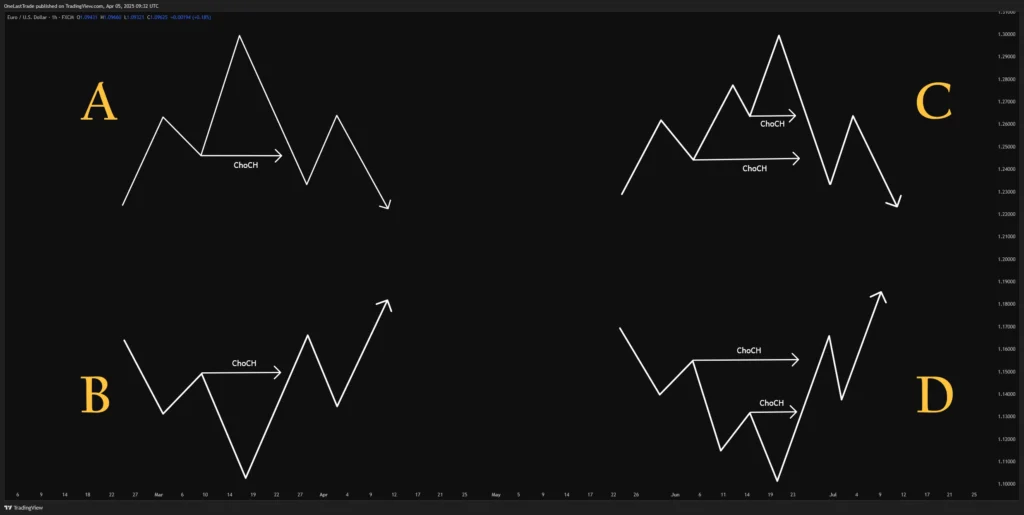
Change of Character (ChoCH): The first sign of a potential trend reversal, identified when the market breaks a minor high or low against the current trend, signaling a shift in momentum.
- A — Bearish Change of Character in an Uptrend.
- B — Bullish Change of Character in an Downtrend.
- C — Bearish Dual Change of Character in an Uptrend.
- D — Bullish Dual Change of Character in an Downtrend.
Key Points of ChoCH:
- Change of character form at the end of a trend.
- First sign of a trend reversal, giving early warning of direction change.
- The best ChoCH impulsively breaks structure with momentum, especially on HTF, signaling a potential reversal.
- A valid ChoCH breaks structure with a candle body close through a major zone, not just a wick.
- For a Change of Character (ChoCH) to be considered valid, price should close beyond the previous high or low with the body of the candle.
- Just a wick piercing the level is often seen as a liquidity grab or false break.
An Important Key Point: Every time a zone breaks, an opposite-side zone automatically forms. For more learning: Change of Character Simplified.
Point 3: A Change of Character (ChoCH) forms when price breaks the most recent (structure/swing) high or low against the current trend, indicating a shift in direction. ✔
Reading Market Intent: Impulsive vs Corrective Moves.
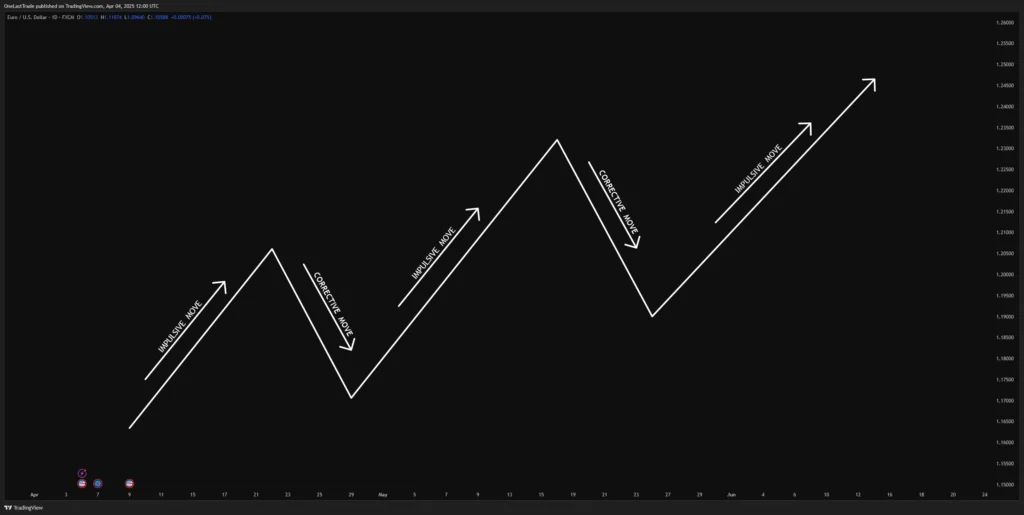
Impulsive and Corrective move in an Uptrend.
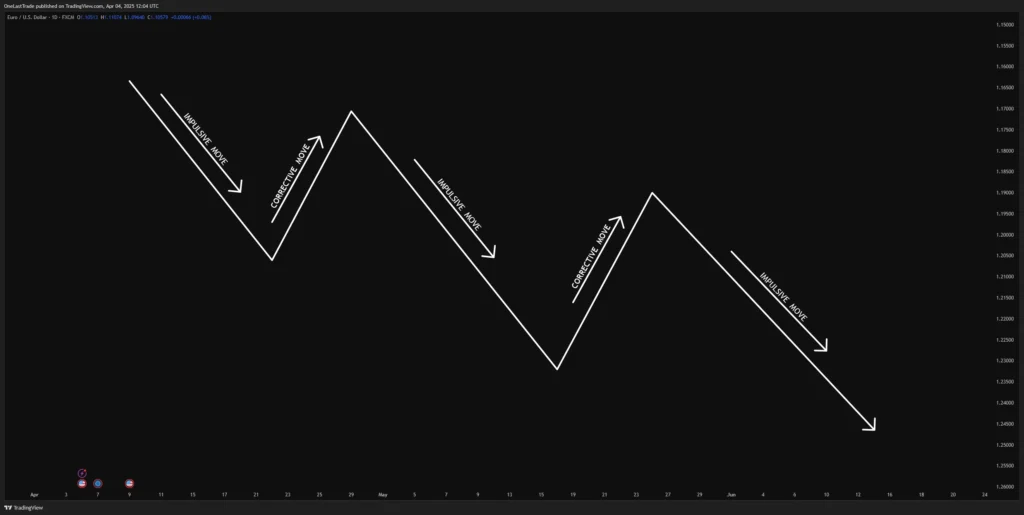
Impulsive and Corrective move in an Downtrend.
About Impulsive move and Corrective move.
🔹 Impulsive Move:
An impulsive move is a strong and directional price movement that aligns with the dominant trend, often marked by large candles, high momentum, and minimal pullbacks. It reflects strong conviction by buyers or sellers and typically breaks key structure levels.
✅ Key points:
- Fast and aggressive
- Breaks previous highs/lows
- Signals trend strength and continuation
✅ Do:
- Trade with the trend direction
- Enter on pullbacks or breakouts after confirmation
- Use lower timeframes to fine-tune entries
- Manage risk and trail stop-loss to secure profits
- Watch for structure breaks to confirm the move
❌ Don’t:
- Don’t go against the move — avoid counter-trend trades
- Don’t chase price without a setup
- Don’t enter late — wait for price to pull back or form a base
🔹 Corrective Move:
A corrective move is a temporary pullback or consolidation against the prevailing trend, usually with low momentum, smaller candles, and overlapping price action. It represents a pause or relief before the trend potentially resumes.
✅ Key points:
- Slower and choppy
- Does not break key trend structure
- Often forms flags, wedges, or ranges
✅ Do:
- Be patient — let the correction finish
- Look for signs of trend continuation (e.g., rejections, structure shifts)
- Use corrections to prepare for the next impulsive move
- Focus on key zones (support/resistance, supply/demand)
- Watch for rejection zones, liquidity grabs, or structure shifts
❌ Don’t:
- Don’t confuse a correction with a trend reversal too soon
- Avoid trading inside choppy or low-volume zones
- Don’t overtrade — corrections often lack clean setups
Point 4: The first key principle is to identify the impulsive and corrective moves, not to rush into a trade. Avoid entering directly into an impulsive move to prevent FOMO. Instead, wait for the corrective move, take my time to plan, and then aim to catch the next impulse. ✔
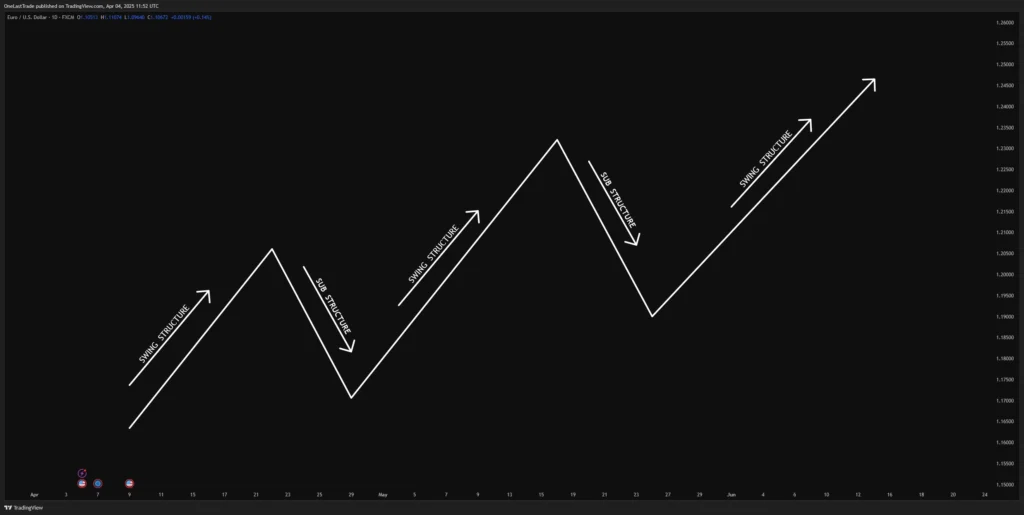
We can refer to impulsive and corrective moves as a swing structure and sub-structure, depending on our trading framework and terminology.
Swing Structure and Sub-Structure
Swing Structure and Sub-Structure in an Uptrend.
Swing Structure and Sub-Structure in an Downtrend.
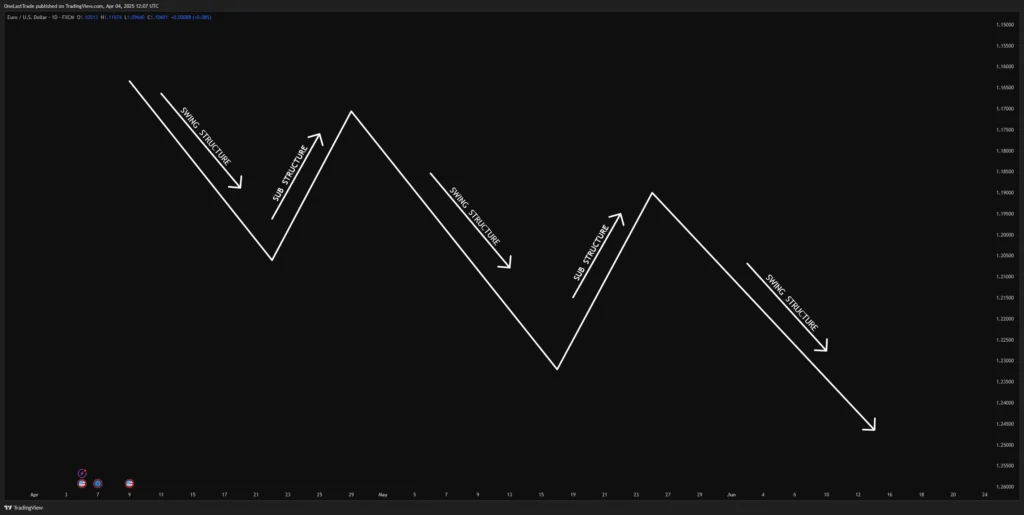
🔹 Swing Structure = Impulsive Move
- This is the main directional move in the trend.
- Typically shows strong momentum.
- Breaks previous structure levels (higher highs/lower lows).
- It’s the big move in the market direction.
🔹 Sub-Structure = Corrective Move
- This is the pullback or retracement against the main trend.
- Usually slower and choppier in nature.
- Doesn’t break major structure in the opposite direction.
- Fits within the swing structure as a minor or internal move.
✅ Example Mapping:
- Bullish Trend
- Price pushes up = Swing (Impulsive)
- Pulls back slightly = Sub-Structure (Corrective)
- Continues upward = Next Swing
- Bearish Trend
- Price pushes down = Swing (Impulsive)
- Pulls back slightly = Sub-Structure (Corrective)
- Continues downward = Next Swing
Swing and Sub Structure in-depth.
Important Must-Read: When looking at Market Structure, we observe smaller trends within larger trends. Impulsive moves form the Swing Structure, while Corrective moves form the Sub-Structure.
Now, because the market operates across different time frames, we can analyze charts on a monthly, weekly, daily, 4-hour basis, and so on. This means trends exist across all time frames.
For example, if the chart image below is a Daily Chart showing an uptrend, and we drop down to the 4-hour or 1-hour time frame, we’ll see smaller trends occurring within the Corrective move. These trends can be traded on their own. So, we don’t need to focus only on the Daily time frame, we can drop down to lower time frames and trade the smaller trends that happen within the Corrective move. This is what we call a Sub-Structure.
Swing and Sub-Structure Trends in an Uptrend.
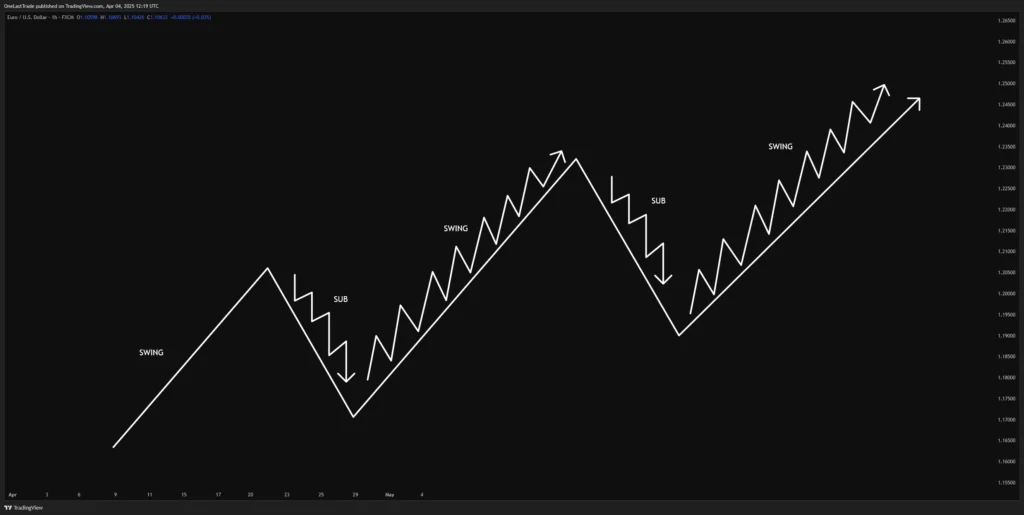
The Swing Structure represents the overall direction of the higher time frame move. The Sub-Structure is the Corrective move. And within the Sub-Structure, we can find full trends on different time frames.
So, we can trade both the Swing and Sub-Structure on their respective time frames. This means that in an uptrend, we can buy during the impulse and sell during the correction.
Swing and Sub-Structure Trends in an Downtrend.
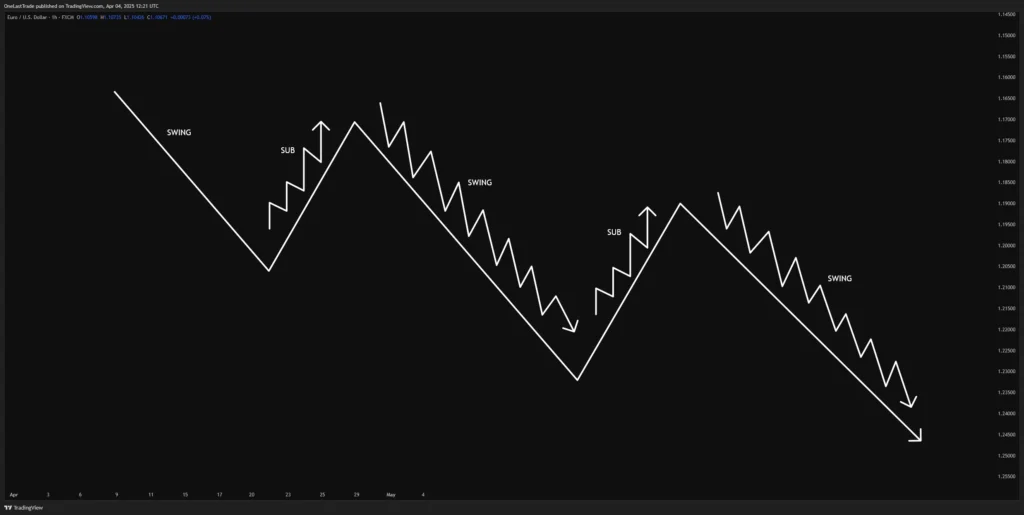
So, in an downtrend, we can sell during the impulsive move and buy during the correction move.
Point 5: Impulsive (Swing) moves are the big, clean, trend-continuation moves with higher risk-reward, while Corrective (Sub) moves are smaller, choppy pullbacks with lower risk-reward. ✔
Closing Comment.
So, I must understand that whenever I plan a trade, I need to identify the current trend and determine whether it is an Impulsive (Swing) move or a Corrective (Sub) move.
This helps me plan better trade conditions and set a proper risk-to-reward ratio, since I have a clearer sense of the trend’s strength and potential continuation.
In the end, knowing the pros and cons of each move type helps fine-tune my trade success rate.