
My Rules and Notes: Momentum and Refined Entries looks very easy concepts but will improve my trade planning and execution.
- Momentum is one of the easiest concepts to learn in trading. It’s not directly part of analysis, but it helps us develop a feel for the market and decide when to enter or exit a trade. It also shows who is in control between buyers and sellers.
- Understanding momentum gives me confidence that I’m analyzing the correct trend direction for the trade. It also helps estimate how long the trade might take to play out, so I can save energy and stay prepared.
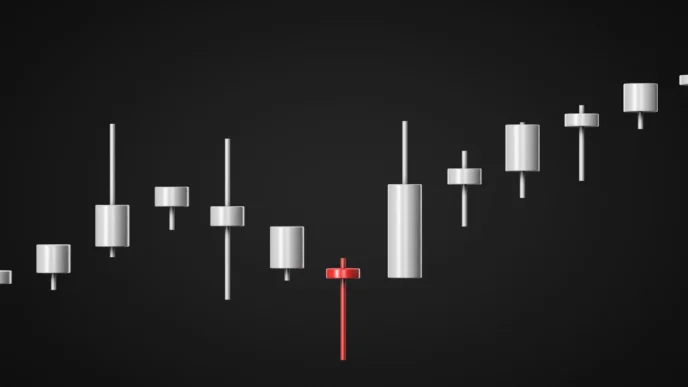
- In a reversal momentum, look for the trend to lose strength and signs of smaller candles forming after larger candles, indicating the strength is weakening. Then, wait for a strong impulsive move that breaks through multiple weak sideways Breaks of Structure (BoS). Finally, wait for the price to pull back and take the trade during the retest phase due to the imbalance.
- Both Risk Entry and Confirmation Entry are good. The key is knowing when to avoid a Risk Entry and choose a Confirmation Entry instead. This is especially important when the incoming move is a strong, impulsive push, as price may break through your zone and hit my stop-loss.
What is Momentum in Trading?
Momentum in trading refers to the speed and strength of a price movement. It shows how quickly price is moving in one direction, either up or down, and helps traders understand who is in control, whether buyers or sellers.
In short, momentum helps traders spot strong trends, time entries and exits better, and stay on the side of strength.
Point 1: Momentum is one of the easiest concepts to learn in trading. It’s not directly part of analysis, but it helps us develop a feel for the market and decide when to enter or exit a trade. It also shows who is in control between buyers and sellers. ✔
Momentum: Continuation Momentum.
Continuation momentum in trading refers to the sustained strength in price movement that supports the ongoing trend. It means the market has enough force to continue moving in the same direction, either up or down, after a brief pause or consolidation.
Key points:
- It shows that buyers or sellers are still in control.
- It usually follows a pullback or sideways movement.
- Traders use it to re-enter trades in the direction of the trend.
Continuation Momentum in an Uptrend.
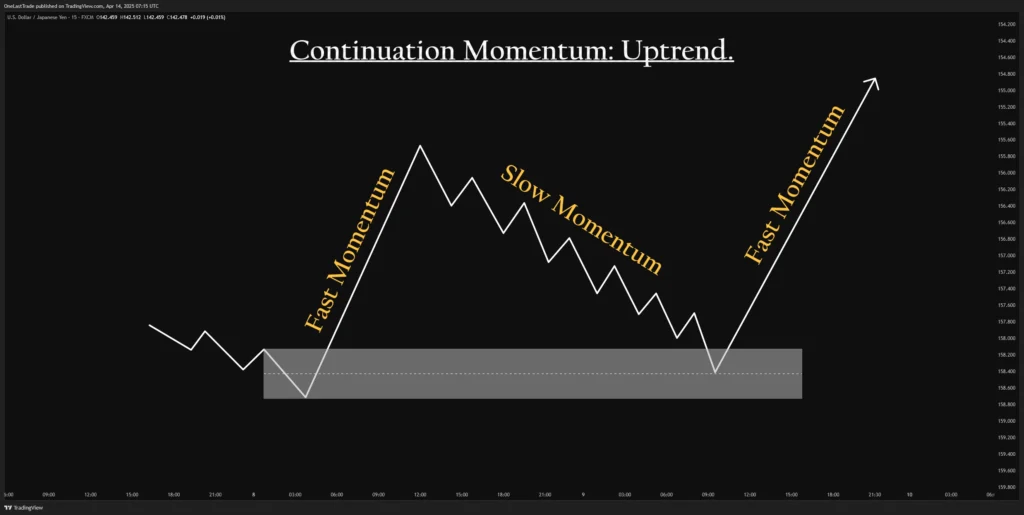
Learning from the above image:
- A slow sideways downside movement followed by a sharp move up which indicates a weak downside momentum and strong upside momentum.
- Example: The move up (impulsive) takes 1 day, while the move back down (corrective) takes 5 to 6 days.
- This indicates strong buying pressure with fewer sellers in the market, meaning buyers are in control, which boosts confidence and confluence to take long positions from the demand zone.
- Buying happens quickly, while selling is slow.
Continuation Momentum in an Downtrend.
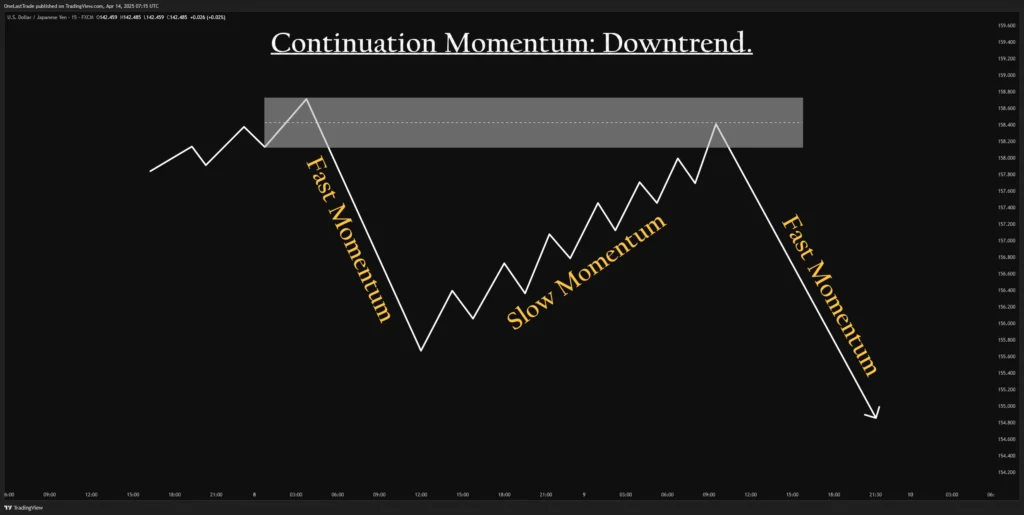
Learning from the above image:
- A slow sideways upside movement is followed by a sharp drop which indicates a weak upside momentum and strong downside momentum.
- Example: The move down (impulsive) takes 1 day, while the move back up (corrective) takes 5 to 6 days.
- This indicates heavy selling pressure with fewer buyers in the market, meaning sellers are in control, which boosts confidence and confluence to take short positions from the supply zone.
- Selling happens quickly, while buying is slow.
Point 2: Understanding momentum gives me confidence that I’m analyzing the correct trend direction for the trade. It also helps estimate how long the trade might take to play out, so I can save energy and stay prepared. ✔
Momentum: Reversal Momentum.
Reversal momentum in trading refers to a sudden shift in price direction, showing that control is changing from one side of the market to the other, from buyers to sellers or sellers to buyers.
Key points:
- It signals a possible end to the current trend.
- It often appears after a strong move begins to lose strength.
- A sharp move in the opposite direction shows that new momentum is building in that direction.
- It can mark the beginning of a trend reversal or a major pullback.
Reversal Momentum in Uptrend.
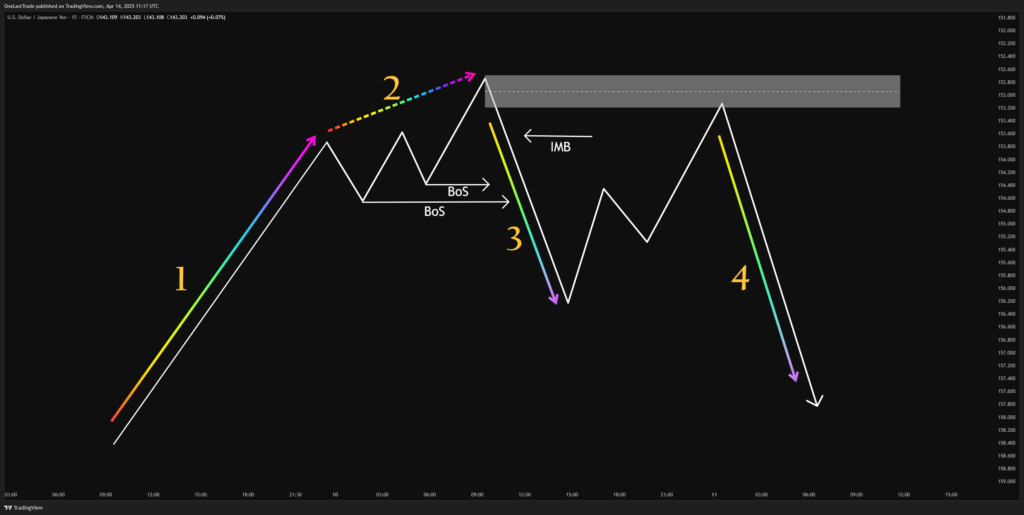
Learning from above image:
- This is an impulsive move in an uptrend with a strong trend.
- This is a sideways uptrend with a weak trend, often seen after the end of an impulsive move.
- This is a strong imbalance and impulsive move to the downside that breaks through multiple weak sideways Breaks of Structure (BoS).
- This is an impulsive move from the supply zone, where I should look to take a reversal short trade.
Reversal Momentum in Downtrend.
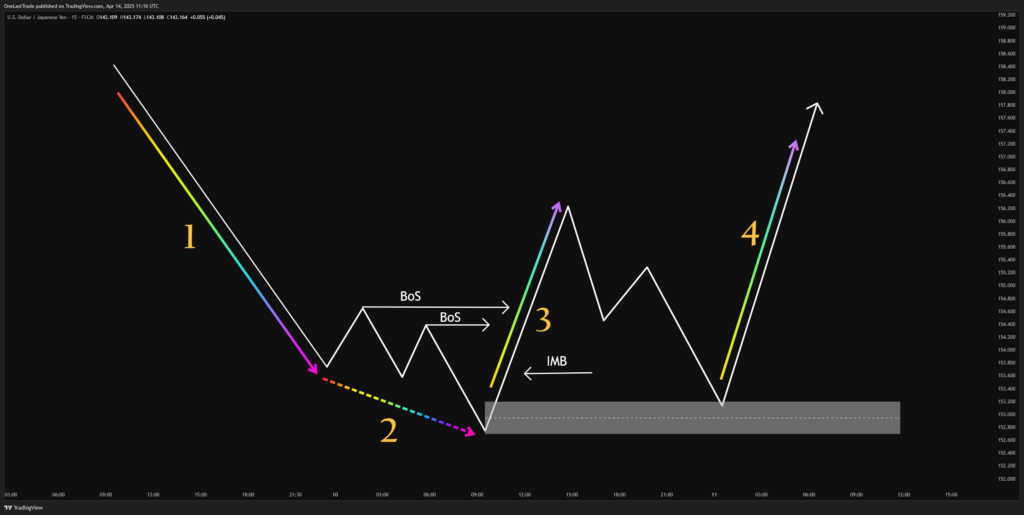
Learning from the above image:
- This is an impulsive move in a downtrend with a strong trend.
- This is a sideways downtrend with a weak trend, often seen after the end of an impulsive move.
- This is a strong imbalance and impulsive move to the upside that breaks through multiple weak sideways Breaks of Structure (BoS).
- This is an impulsive move from the demand zone, where I should look to take a reversal long trade.
Very Important Note: The best reversal trade occurs when an imbalance forms opposite to the main trend at the end of a major move, breaking through multiple Breaks of Structure (BoS). This indicates that trend continuation participants are weakening, while institutions are stepping in with strong momentum, reversing the trend and creating the imbalance. Ideally, the pullback should also be weak, which helps double-confirm that the reversal move is now stronger, as price struggles to retest the previous zone. We then trade the reversal move, as it presents high-probability confluence conditions.
Point 3: In a reversal momentum, look for the trend to lose strength and signs of smaller candles forming after larger candles, indicating the strength is weakening. Then, wait for a strong impulsive move that breaks through multiple weak sideways Breaks of Structure (BoS). Finally, wait for the price to pull back and take the trade during the retest phase due to the imbalance. ✔
Redefined Entries
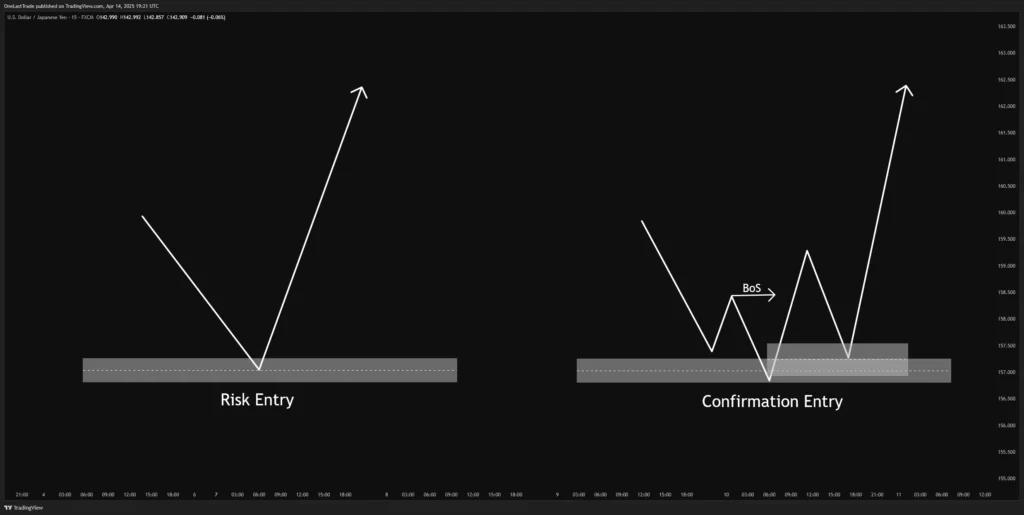
Risk Entry
🔹Risk Entry: A risk entry is when you enter a trade immediately at a key level (like a demand/supply zone or imbalance), without waiting for price to confirm it’s going to reverse.
Purpose:
You’re trying to catch the move early with the best entry price and tightest stop loss.
Pros:
- Early entry = better Risk:Reward ratio (RRR)
- Smaller stop loss = bigger potential gain
Cons:
- Lower probability: Price might break the zone instead of reversing
- Higher chance of stop-out
Confirmation Entry
🔸 Confirmation Entry: A confirmation entry waits for price action to prove the reversal—like a Break of Structure (BoS), shift in order flow, or reversal candlestick pattern.
Purpose:
To increase your probability of success by trading with confirmation that the reversal is happening.
Pros:
- Higher probability: More signs that your trade idea is valid
- Greater confidence in the move
Cons:
- Entry happens later = lower RRR
- Sometimes you miss the trade if it moves quickly
Quick Summary Table: Risk Entry Vs Confirmation Entry.
| Feature | Risk Entry | Confirmation Entry |
| Entry Timing | Before confirmation | After confirmation |
| Risk:Reward Ratio | High | Moderate |
| Win Rate | Lower | Higher |
| Stop Loss | Tighter | Wider (usually) |
| Confidence Level | Moderate | High |
| Use Case | When I am confident in zone | When I want more safety |
Very Important Note: To make a Confirmation Entry high-probability and accurate, wait for the price to enter the zone, then shift to the Low Time Frame (LTF) and look for a confirmed Break of Structure (BoS) in the opposite direction. Once confirmed, mark the new zone on the (LTF) and take your entry from there.
Point 4: Both Risk Entry and Confirmation Entry are good. The key is knowing when to avoid a Risk Entry and choose a Confirmation Entry instead. This is especially important when the incoming move is a strong, impulsive push, as price may break through your zone and hit my stop-loss. ✔
Closing Comment.
Momentum and Refined Entries are easy to understand, but I need to include them in my trading plan and practice them consistently to build confidence and improve my trade execution.