

My Rules and Notes: Even when HTF, MTF, and LTF align in one trend, I need to know which market phase to trade from in order to take high-probability setups.
- Whenever we analyze a chart, the main question we need to ask ourselves is: “Who is in control of price, supply or demand?“
- Before taking any entries, do measure the premium-discount tool to calculate the RR visually. So, I reduce the risk when entering for counter trend moves.
Mechanical Trading Strategy: Fundamental Level
In this topic we are going to learn how price moves on a fundamental level.
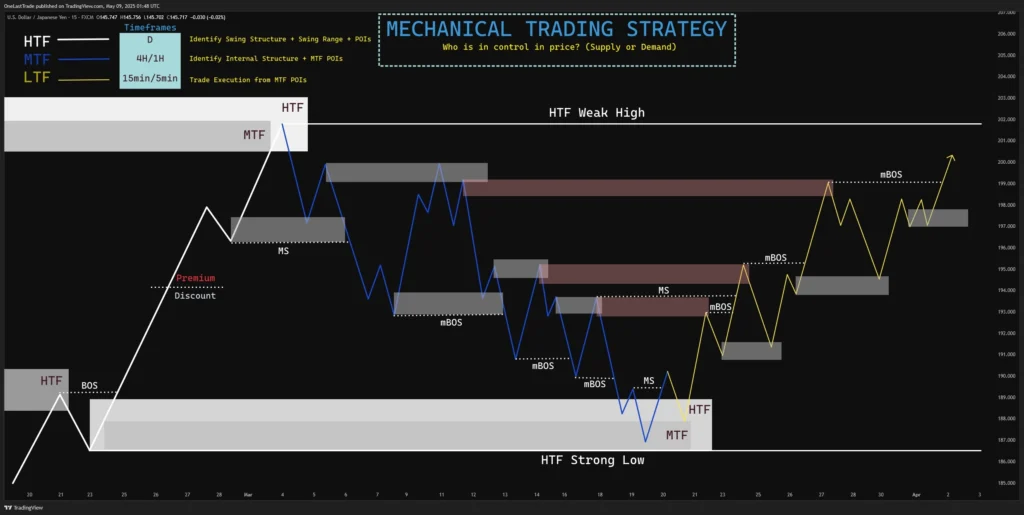
Understanding the mechanical trading strategy in an story mode:
Time Frame Importance:
- For this strategy, we focus on three main time frames: HTF (Daily), MTF (4Hr/1Hr), and LTF (15min/5min).
- On the HTF, we identify the swing structure to determine whether price is bullish or bearish, and whether it’s in a continuation or pullback phase.
- On the MTF, we identify the internal structure, what price is doing within the swing range and mark up MTF points of interest (POIs).
- On the LTF, we actually execute our trades based on refined entry models.
Higher Time Frame view:
- Price is in an uptrend within a bullish order flow. It reaches an unmitigated supply zone on the higher time frame (HTF) and starts pulling back.
- More demand steps in, and price creates a break of structure (BoS) by breaking the last swing high. We can then expect price to start pulling back again.
- Once again, price reaches an unmitigated supply zone. At this point, our job is to anticipate a pullback from that point of interest.
- Once price starts pulling back, we should narrow our focus to a specific section of the price action. We do this by marking out the strong low and the weak high.
Medium Time Frame view:
- Price will turn bearish temporarily to facilitate the pullback.
- Eventually, price pulls back all the way down to the demand zone created from the strong low.
- This is when we anticipate the pullback may soon come to an end.
- At this demand zone, price could turn bullish again creating a (shift of structure, shift of order flow, and a flip from supply to demand).
- At this point, the internal structure aligns with the external (swing) structure.
Lower Time Frame view:
- Once price begins to form higher highs (HH) and higher lows (HL), the final step is to look for entries on the LTF from the demand zone.
- This is because the HTF, MTF, and LTF trends are all aligned, and all confluences are in our favor.
In this mechanical trading strategy, I’ve understood how price moves on a fundamental level and how the entire cycle repeats itself.
Important Note: Whenever we analyze a chart, the main question we need to ask ourselves is: “Who is in control of price, supply or demand?“
Market Phases: Timing the Entry
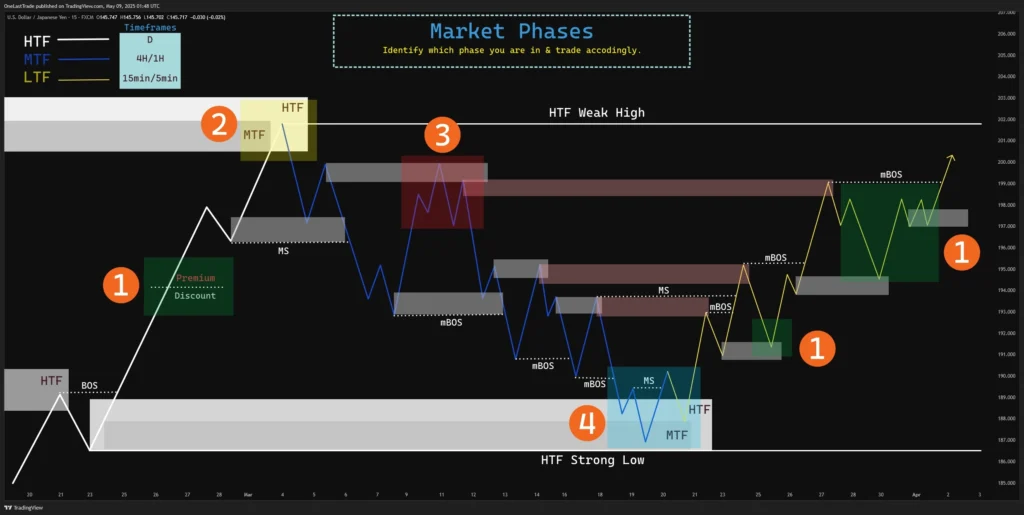
Learning from the above image:
1 -> PRO SWING + PRO INTERNAL
- Ride HTF Trend & Order Flow.
- Target weak swing highs.
- High probability setups.
2 -> COUNTER SWING + COUNTER INTERNAL
- Facilitate swing structure pullback.
- Look the reversal setups (always wait for MS).
3 -> COUNTER SWING + PRO INTERNAL
- Play MTF pullback or reversal if HTF permits.
- Look for short term selling opportunities to ride pullback.
4 -> PRO SWING + COUNTER INTERNAL
- Anticipate end of swing pullback & shift of order flow.
- Look for reversal setups to trade with HTF order flow.
Pro Tip: Before taking any entries, do measure the premium-discount tool to calculate the RR visually. So, I reduce the risk when entering for counter trend moves.
What did I learn in market phases entry strategy?
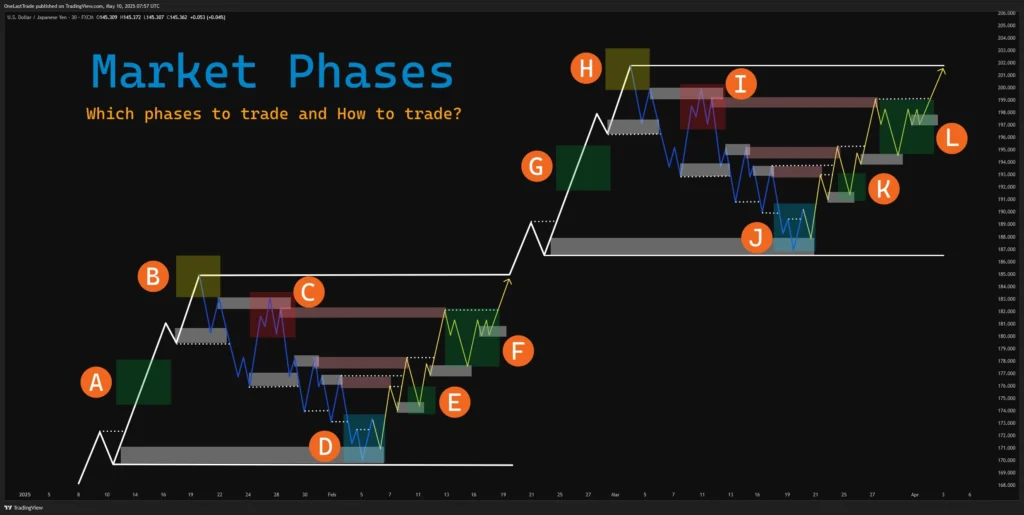
Learning from the above image:
We will use timeframes HTF(Daily), MTF(4hr/1hr) and LTF(15min/5min).
We can see that market is in uptrend making (HH & HL) and repeating the entire cycle. So, the most important question is which phases to trade and how to trade them.
From A and G:
- Ideal for pro-swing long trades but be careful because after a BOS the price has to pullback to a demand zone and we could be stopped.
- So, take long trade and target previous unmitigated supply zone. Be cautious for the pullback move.
- Need to enter cautiously and exit fast.
- Score – 5/10 and RR – medium to low.
From B and H:
- Best counter-swing short trade to the first demand zone or extreme demand zone, but it is harder to predict or catch exact reversal area.
- Wait for bearish market shift on MTF or sharp fall which confirms the smart money has entered. Also wait for liquidity sweep.
- Need to enter fast and exit fast.
- Score – 3/10 and RR – very high.
From C and I:
- Perfect counter-swing short trade to the extreme demand zone because we got market shift on MTF, we got failed reaction from demand zone formed a D2S Flip zone and is a more confirmed entry.
- At this area, we can shift from MTF to LTF and look for short trades with tight stop-loss and target perfect RR or extreme demand zone.
- Need to enter normally and exit fast. (Use premium-discount tool.)
- Score – 8/10 and RR – high.
From D and J:
- Excellent pro-swing long trade to the HTF weak high because this is the POI where there is a extreme demand zone and market shift can happen aligning MTF with HTF trend.
- Just wait for a market shift (from internal bearish to bullish), inducement, and a liquidity sweep, then target the HTF weak high.
- Need to enter normally and exit normally.
- Score – 9/10 and RR – very high.
From E and K:
- Very high probability pro-swing + pro internal long trade because at this point price is bullish, already had a market shift in MTF and LTF aligning with HTF. Now this is a continuation move means we can use confirmed entry method.
- Shift from MTF to LTF, wait for a market shift, pullback, and entry from the demand zone, then target the HTF weak high. All parameters such as HTF, MTF, and LTF are aligned, and the trend is in a continuation move.
- Look for inducements, a liquidity sweep, a smart money V-shape reaction, and a clean candle close confirming the market shift to enter the trade.
- Need to enter with precision and exit normally. (Same as Multi-Timeframe Market Structure: 123 Boom.)
- Score – 10/10 and RR – high.
From F and L:
- Ideal for long trades, but be cautious as we are entering at the final phase, even though HTF, MTF, and LTF are aligned. A nearby supply zone could trigger smart money manipulation again.
- We could get a very small reward or very high reward if market makes a new higher high.
- Avoid this trade, or rely solely on price action aligned with market conditions, inducements, and liquidity concepts.
- Need to enter cautiously and exit fast. (Makes no sense buying at premium.)
- Score – 2/10 and RR – very low or very high.
So what are the market phases I should enter and use it to my advantage?
According to this uptrend, I would choose and stick to the following market phases as below:
Market Phases: (D & J), (E & K) because I will be aligning with HTF trend for long position trades.
And
Market Phases: (C & I) because to take counter trend trade we need internal market shift, D2S Flip Zone and price is in premium for short position trades.
Closing Comment.
Understanding the market phases helps me decide when to enter a trade during the right phase, increasing the probability of success and ensuring a good risk-to-reward ratio.
So, do live test and practice this more…then I can do 1-2-3 boom. That’s it.