

Here are all my doubts, observations, and revision logics to support that I am following the correct knowledge. I will continue adding more as I encounter major doubts in the coming days.
1. I want to know which Swing Low is correct when market shifted from bearish to bullish? (Scenario: Market created Bullish CHOCH and then multiple Bullish BOS.)
- Is Swing Low below the CHOCH?
- Is Swing Low below the Bullish BOS but which BOS, the first one or last one?
Answer: ChatGPT tells ->
Option 1: Swing Low below the CHOCH ❌
- This low is part of the old bearish structure.
- It’s the last bearish low, but not part of the new bullish leg.
- Not valid as a bullish swing low.
- CHOCH signals a potential trend change — it’s a warning, not confirmation.
- Market may still:
- Pull back deeper,
- Continue bearish,
- Or range before choosing direction.
Option 2: Swing Low before the first Bullish BOS ✅
- This is the first true Higher Low (HL) of the new trend.
- Price respects this low → then breaks a previous high → this confirms bullish structure.
- This is your first valid bullish Swing Low.
Option 3: Swing Low before the last Bullish BOS ✅ (but with nuance)
- This is also a valid swing low, but it’s a later HL, part of the ongoing bullish structure.
- It’s still valid, but it depends on why you’re identifying the swing low:
- For structure marking: use the most recent HL before the latest BOS.
- For trend shift: use the first HL before the first BOS.
1. My Answer – What I Understood?
- In market structure, we use HH (Higher High), HL (Higher Low), LH (Lower High), LL (Lower Low).
- In a bullish trend, the swing low is typically a Higher Low (HL).
- In a bearish trend, the swing low is a Lower Low (LL).
So, the answer is:
In a bullish trend, valid swing lows = HLs because it is in a confirmed trend and we mark Swing Low’s only at HL not on LL in a bullish trend.
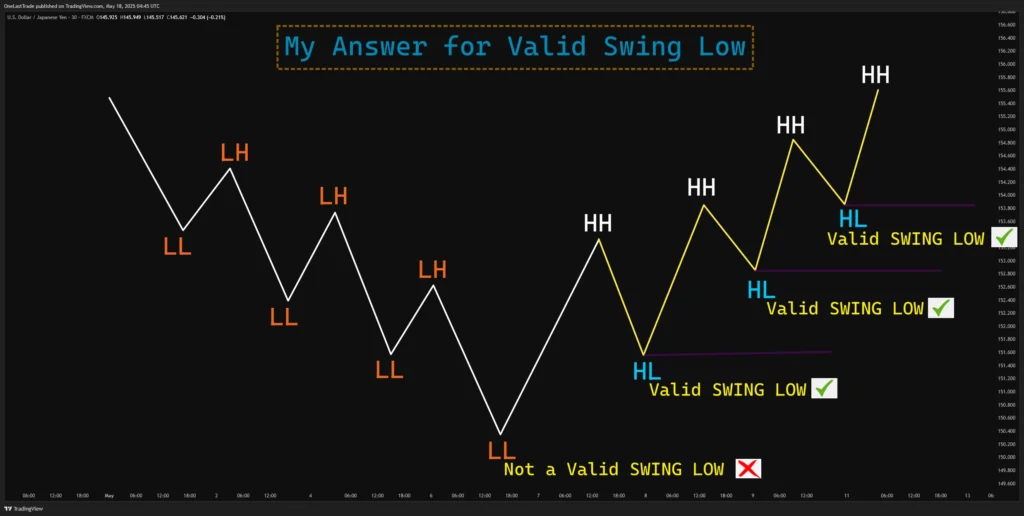
- The swing low before the CHOCH is not valid for the new bullish trend, because it belongs to the old bearish structure (LL).
- The swing low before the first Break of Structure (BoS) is valid because it’s part of a confirmed bullish trend — it’s a Higher Low (HL).
- The swing low before the last Break of Structure (BoS) is valid because it’s part of a confirmed bullish trend — it’s a Higher Low (HL).
My Observation: I can visually see the chart to tell a swing low on basis of inefficiency and swing structure. So, sometimes the last second HL is also a valid swing low because market created BOS & imbalances with (Big move upside) and next a mini BOS with (small move upside) and is pulling back. See in the image below to understand the point.
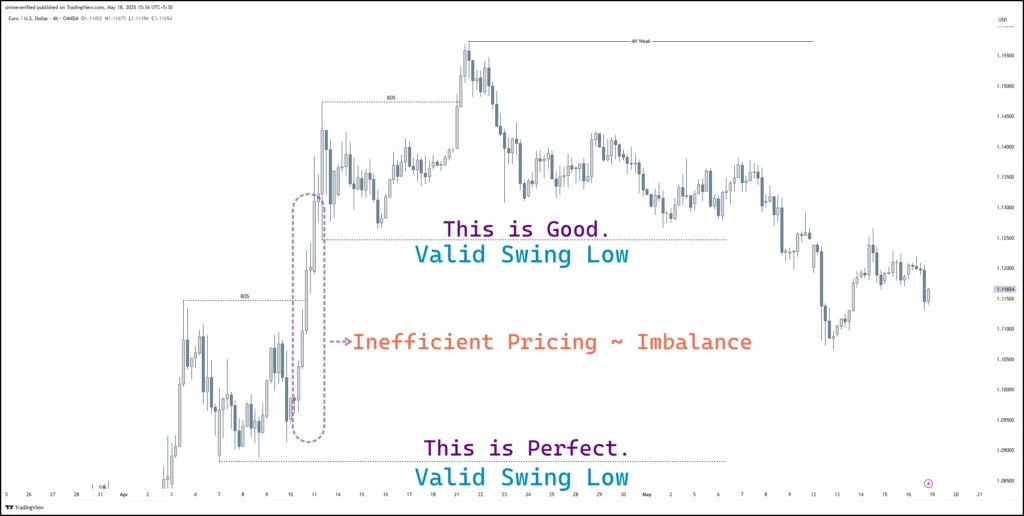
See, Both the Swing Lows are correct but the main question to ask ourselves when visually seeing the chart is (Which one is likely to break?, Which one will hold?). I see the second Swing Low is the perfect one because it has imbalances meaning Smart money has entered before and is likely to enter again in this same area. ✔
————————–Doubt Cleared————————–
2. Best Forex pairs to trade with each session?
Answer: By combining ChatGPT & Babypips timings, there is only a little change for Asian session time. –>
Asian Session IST: 2:30 AM – 2:30 PM
Asian Session volume starts picking up from 3:30 AM. (So this is also the right opening time.)
USD/JPY – High liquidity, influenced by Japanese news.
AUD/USD – Active due to Australian market hours.
NZD/USD – Also sees decent movement, especially early in the session.
AUD/JPY & NZD/JPY – Good volatility in cross-pairs during this session.
Tips: Focus on JPY, AUD, and NZD pairs. Volatility is lower compared to London and New York, but trends can be cleaner.
London Session IST: 12:30 PM – 9:30 PM
EUR/USD – Very liquid, tight spreads.
GBP/USD – High volatility, especially around UK data releases.
EUR/GBP – Moved by both Eurozone and UK news.
USD/CHF – Often active due to European banking flows.
Tips: This session overlaps with the tail of the Asian session and leads into the New York open — ideal for trend moves and breakouts.
New York Session IST: 5:30 PM – 2:30 AM
EUR/USD – Very active with US economic news.
GBP/USD – Volatile and often driven by both UK and US events.
USD/CAD – Good to trade especially when oil or Canadian data is released.
USD/JPY – Remains volatile into New York.
Tips: Highest volatility happens during the London–New York overlap (IST: 5:30 PM – 9:30 PM). Look for sharp moves and news-based momentum.
Important: To trade Asian high/low strategy we need to use these timings:
2. My Answer – What I Understood?
I have to focus on top four major currency pairs (no matter what) as a beginner, that are as below:
- EUR/USD
- GBP/USD
- USD/CAD
- USD/JPY
As a beginner, I don’t need to go for the sessions strategy. I just need to enter and exit according to the supply/demand zones. That’s it.
If the strategy (entry) falls on the session period of that currency, it is well and very good so I can have clean move with strong volume and volatility. For now, I don’t have to worry about that stuff because I am a beginner.
————————–Doubt Cleared————————–
3. Figuring Timings for Asian Liquidity high-low strategy.
Answer: By ChatGPT and some random YouTube resources.
ChatGPT tells –>
- Sydney Session:
🟢 Opens at 2:30 AM IST
🔴 Closes at 11:30 AM IST - Tokyo Session (Main Asian liquidity):
🟢 Opens at 5:30 AM IST
🔴 Closes at 2:30 PM IST
ChatGPT tells –> Mark the High & Low formed between 5:30 AM and 8:30 AM IST.
- Early Session Activity Peaks
- Most institutional orders and news-driven moves in the Asian session tend to occur in the first few hours after the open (5:30–8:30 AM IST).
- After this, the session often consolidates or loses momentum.
- Reliable Range Formation
- The high and low set between 5:30 AM – 8:30 AM IST often acts as a liquidity pool.
- London traders use this range to hunt stops just before their own session opens at 1:30 PM IST.
- Smart Money Strategy Influence
- Many ICT/SMC-style traders treat this early range as a tool to identify inducements or fakeouts before real moves happen later in the day.
Tips: We now know that the Full Asian Session is from 2:30 AM to 2:30 PM.
3. My Answer – What I Understood?
My Thinking –> But I think it is ChatGPT range is small (5:30 AM to 8:30 AM). What I think it could be from (5:30 AM to 11:30 AM) because this range involves Tokyo open and Sydney close. Also, the range now is little bigger.
Here, I don’t believe ChatGPT because every time it tells different answers.
For Asian Session liquidity sweep strategy use time from 5:30 AM(Tokyo Opens) to 11:30 AM (Sydney Closes).
Note: I should use Asian Range Liquidity Strategy Timing (5:30AM to 11:30AM). There may still be doubt until I keep trying or observe it live.
————————–Doubt Cleared————————–