

My Rules and Note: I’ve learned these three strategies and now understand how traders catch clean, high-quality trade setups and the logic behind them.
- I need to practice these setups, as they will help refine my entries. I now know what to look for in point of interest areas or zones.
3-Step Framework Strategy ✔
Video Link: 3-step framework strategy.
In this 3-Step Framework Strategy, we will use only two time frames:
- 4H TimeFrame (HIGHER TIMEFRAME)
- 15Min TimeFrame (LOWER TIMEFRAME)
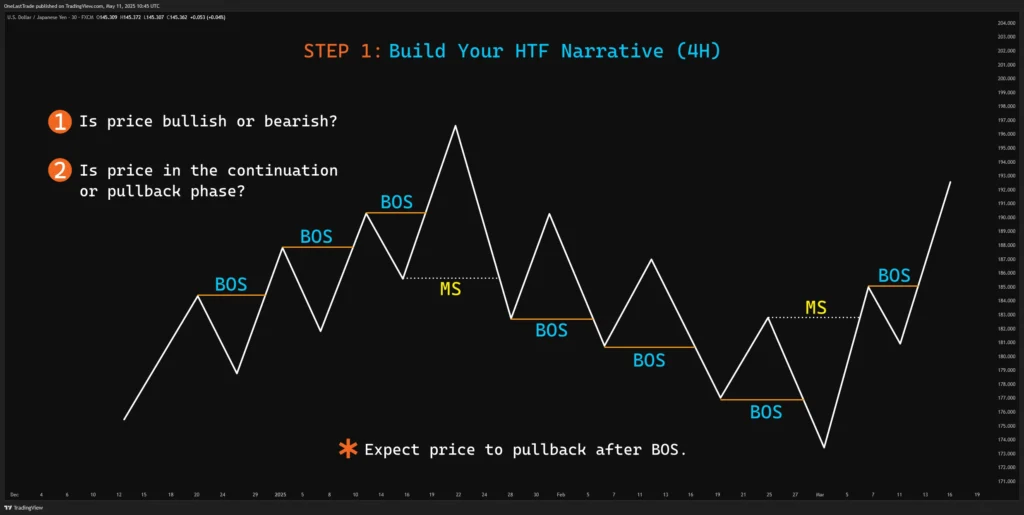
Learning from the above image:
The first step is to build our HTF Narrative (4H) and what is price doing right now. So, we can identify our trade bias.
To do:
- Is price bullish or bearish?
- If price is Bullish we want to buy from HL(Higher Low) and if Bearish we want to sell from LH(Lower High).
- Is price in the continuation or pullback phase?
- If price is in a Continuation Phase, wait for it to pullback and start creating structure (Don’t enter in for a trade immediately).
Pro Tip: Every time price creates a BOS, wait for the price to pullback and then enter from supply/demand zone.
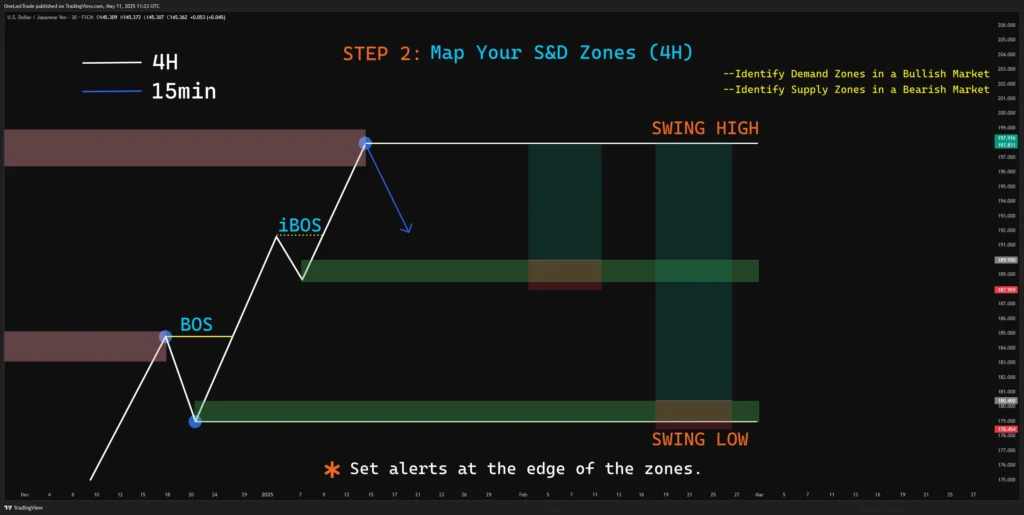
Learning from the above image:
In the second step we are still on the 4H timeframe and we need to mark out all the required supply or demand zones.
To do list:
- Identify Demand Zones in a Bullish Market.
- Identify Supply Zones in a Bearish Market.
According to the image, we can see that the market is in a continuation phase, as it has created a Break of Structure (BOS). We can still buy during the impulsive phase, but it is recommended to enter a buy after the pullback is complete, to get an optimal entry point.
Once the pullback begins, the price will start forming lower highs and lower lows on the lower time frame (LTF). At this point, it’s important to remain aware of the higher time frame (HTF) trend and understand that the market is temporarily turning bearish to facilitate the HTF pullback.
Therefore, we cannot assume that the price is reversing into a bearish trend just yet, because the last (HTF) higher low has not been broken. This means we are still trading within the current swing range.
My Doubt about the word “facilitate” got cleared by ChatGPT
Question: What is the meaning of facilitate according to the above sentence? Does it mean – To relate?
Answer: In the sentence “the market is temporarily turning bearish to facilitate the HTF pullback,” the word “facilitate” means:
- To make something easier or to help bring something about.
So in context, it means:
- The temporary bearish move on the lower time frame is helping to make the pullback on the higher time frame happen.
- It does not mean “to relate.” A better synonym here would be “support,” “enable,” or “allow.”
Pro Tip: Marking these zones helps us stay aligned with the higher time frame trend, and we want to trade with the trend. Wait for price to come back to any of the Demand Zones -> Wait for Entry Model to present itself -> Enter in for a trade.
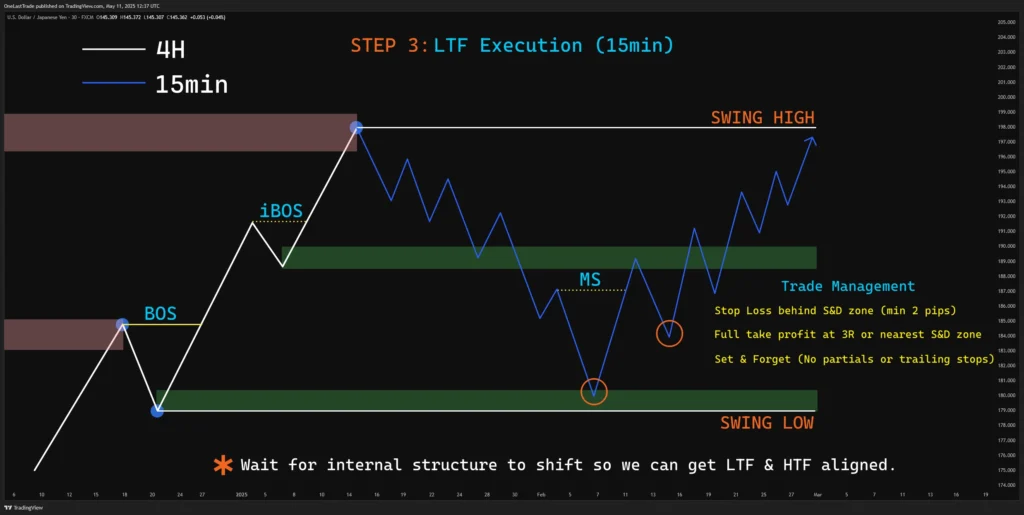
Learning from the above image:
The third step is execute our trade after price has entered into our demand zone. In the image above, we can see the white line is 4H timeframe and blue line is 15min timeframe.
We can see that price has created a short-term bearish pullback, forming lower lows (LLs) and lower highs (LHs) within the internal structure of the lower time frame (LTF), in order to facilitate the pullback of the higher time frame (HTF) trend.
We want to wait for this pullback to complete and for demand to step into the market and overwhelm the sellers. That’s when we know the internal (LTF) structure has shifted from bearish to bullish. At that point, the LTF trend aligns with the HTF trend, and we can capitalize on high-probability trade setups.
We know that the Swing Low (extreme zone) is the last line of defense, so we can be a bit more aggressive with our approach. As soon as price mitigates the 4H extreme demand zone, we need to drop to the lower time frame (LTF) to look for our entry model.
To do list:
- Look for market shift in 15min LTF. Order Flow Transition (Price changes direction, “Bearish to Bullish”).
- We need some form of Liquidity to be swept. Liquidity usually comes in the form of V-shape (sharp reaction – aggressively going in and out movement).
- Hint: Above & below every swing there is available liquidity for institutions(Big Banks).
- Wait for the price to pullback to the demand zone which created the market shift.
- Set entry limit order on the edge, stop-loss behind the zone or entry manually.
Pro Tip: Price is fractal. Whatever happens on the HTF must first happen on the LTF.
We can also do this: Let the 4H trend price hit the demand zone to mitigate, then shift to the 15-minute timeframe and wait for a market shift. This method also works the same, it’s as simple as that.
Main point for entry: If we miss the same entry model at the 4H extreme demand zone, don’t worry. Just wait for the next market shift in LTF and then apply the same entry model. Please refer to the two circles I’ve drawn in the image, where we can look for this same setup.
Trade Management Rules:
- Stop-loss behind S&D zone (min 2 pips).
- Full take profit at + 3R or nearest S&D zone.
- Set & Forget (No partials or trailing stops).
Myth Confirmed: For a BOS to be valid, the candlestick body must close below the low/high according to the structure. Proof: 7:16:34 video. // While others use body-to-body. //
Additional Counter Trend Trade Logic:
We can also trade the short-term pullback to the demand zone (a bearish counter-trend), but we must be cautious. As price enters any of these demand zones, it can switch back to bullish at any time, causing the market to resume its upward movement. Therefore, the best time to trade the counter-trend is at the very beginning of the pullback.
// 3-Step Framework Strategy Finished. //
Sniper Entry Strategy ✔
Video Link: Sniper entry strategy.
With this sniper entry strategy model, we can capture large moves using the same 3-step framework as above. The secret to capturing large moves lies in the time frame itself, the 1-minute chart.
In this sniper entry strategy, we will use four timeframes and the same 3-step framework as above. The four timeframes we will use are: Daily, 4H, 15min, 1min.
The simplest solution here is to enter on 1-minute time frame. Use that same framework as above and that’s it.
There are no fixed time frames like 4H or 1H. Do check what works the best for me. But in the video, using the Daily, 4H, 15min, and 1min time frames makes sense, and I think the logic is excellent.
The secret solution for biggest RR: Use 1-minute time frame for executing trades for biggest risk-to-reward ratio and catch huge moves. (The Truth/Reality Confirmed.)
// Sniper Entry Strategy Finished. //
1-Minute Scalping Strategy ✔
Video Link: 1-minute scalping strategy.
In this scalping strategy, we only are going to use two time frames:
- (15min) Higher timeframe for narrative.
- (5min/1min) Lower timeframe for trade execution.
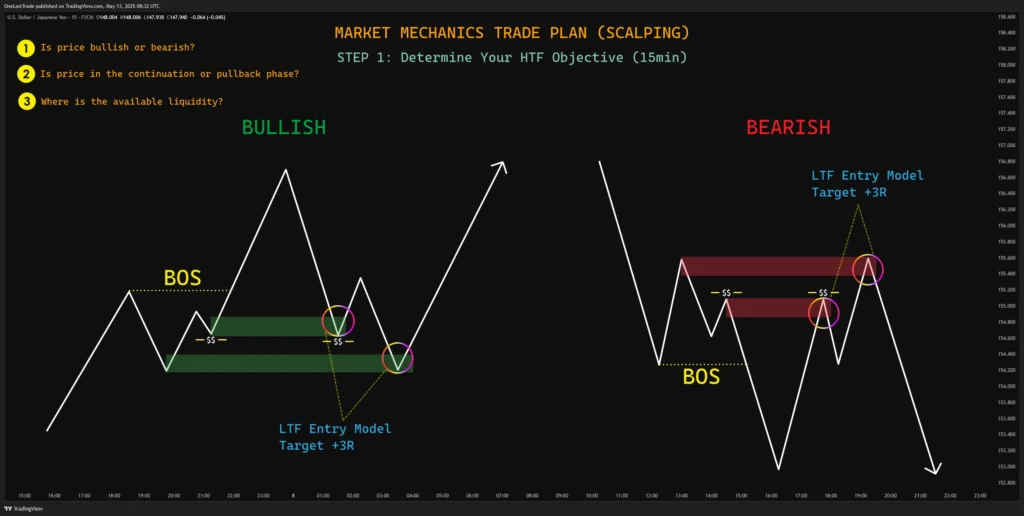
Learning from the above image:
Analyzing the (15min) HTF chart, I need to build a narrative using these three question as below:
- Is price Bullish or Bearish?
- Is price in Continuation phase or the Pullback phase?
- Where is the available Liquidity?
Pro Tip: You see the four circles in the image, that is where I want to look for entry model on the lower time frame after price tap into our POI.
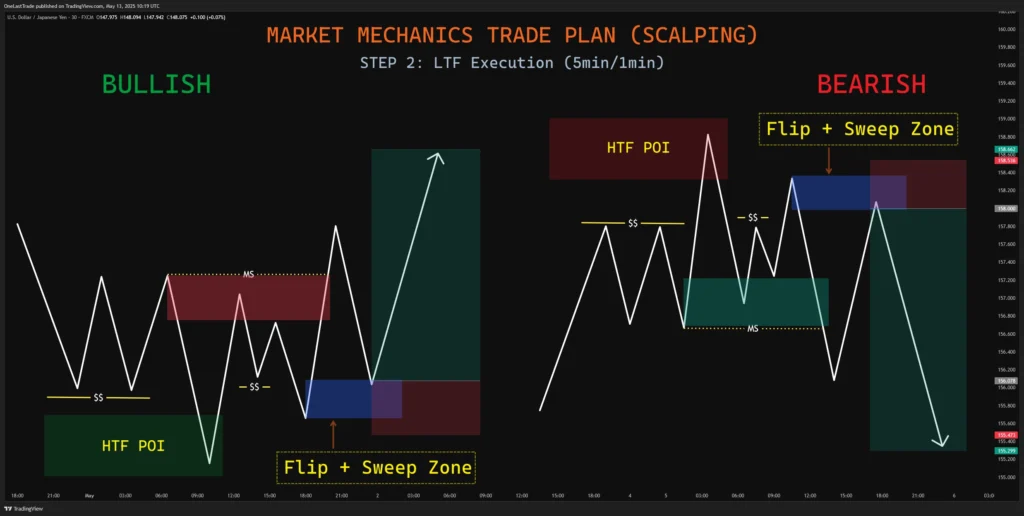
Learning from the above image:
Analyzing the (5min/1min) LTF chart, I need to apply the Flip + Sweep Entry Model.
- Once I spot a point of interest, I drop to a lower timeframe (5min or 1min) to confirm an entry before trading.
- I can use either 5min or 1min time frame. (Note: Don’t use 1min timeframe unless I am a experienced with this entry model.)
- Look for pattern as shown in the image above. (Very Strict: Always wait for Liquidity Sweep before entry.)
- Look for a strong, sharp V-shape reaction. It tells us that all the retail traders are stopped out of the market.
- Next, look for the Flip Zones. (Flip Zones are those zones that cause other zones to fail.)
- Again don’t rush. Wait for early participants and let the market sweep their liquidity.
- Lastly, wait for the Market Shift to happen and then enter from the Flip + Sweep Zone.
Making the above steps more easier in just 4-steps:
- Wait for Liquidity Sweep.
- Wait for Flip + Sweep.
- Wait for Market Shift.
- Enter at the Flip + Sweep.
Pro Tip: Look out for sharp V-shape reaction and multiple Liquidity Sweeps at the POI.
Bonus: Market Mechanics Trade Plan
Make every trade count. Trade like a sniper. Focus on one good trade after the other. Link: Trade Plan 2025.
1. Trade Process
- [ ] Identify 15min Structure + Trend
- [ ] Wait for price to pullback to Discount / Premium
- [ ] Determine where is the available liquidity
- [ ] Enter at 15m high probability zone that swept LQ
- [ ] Set entry limit order on edge of POI, stop loss behind zone
2. Trade Management
- Full take profit at +3R
- Set & Forget (No partials or trailing stops)
3. Capital Management
- Risk 1% per trade
- Maximum 3 losses per day
- Minimum 2 pips stop loss
- Pairs: EUR/USD, AUD/USD, GBP/USD
- Time: 2pm – 5pm(London), 7pm – 10pm(New York), Singapore Time
Closing Comment
I’ve learned a lot about identifying entries at points of interest and the logic behind them. I now feel confident that my trading journey will be smooth. Even if struggles or obstacles come my way, I will overcome them and continue to practice.
The part I liked most in The Trading Greek video was learning to align all timeframes, confirm market shifts, and understand liquidity concepts. Now that the course is over…
Happy sailing…!!